
Egyptian Astrology: How the Ancient Egyptians Read the Sky — and Where to See It Yourself
***Edited April 9, 2026
Long before horoscope columns existed, the ancient Egyptians were watching the sky with extraordinary precision. Their observations were not casual. They were systematic, religiously significant, and practically essential — because the survival of their civilization depended on understanding the movements of stars and planets.
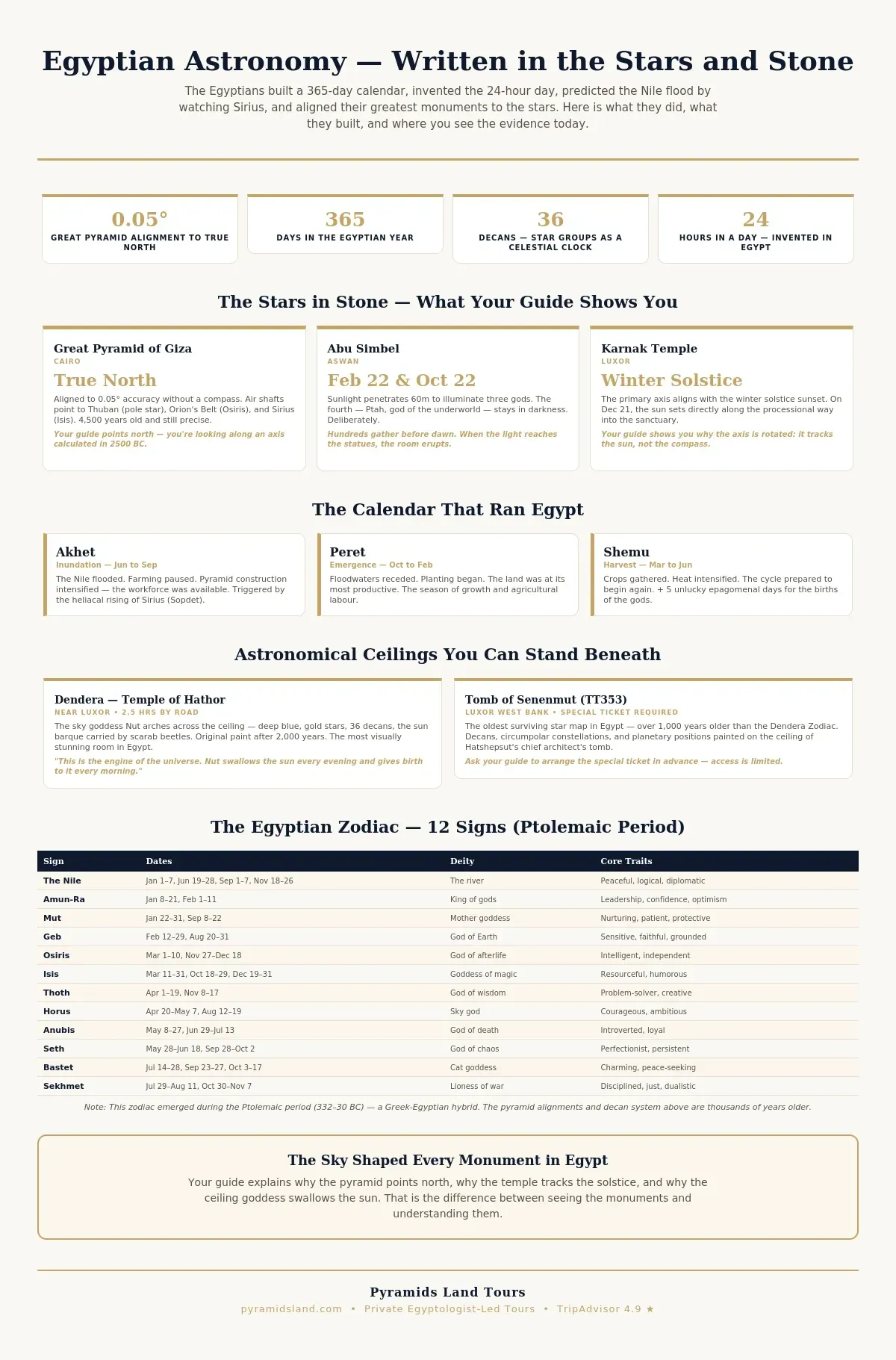
The Egyptian relationship with the sky produced the 24-hour day, a 365-day calendar, pyramid alignments accurate to 0.05 degrees, and some of the most beautiful astronomical ceilings in the ancient world — several of which you can still stand beneath today.
This article explains what the Egyptians actually did with the sky, what they built because of it, and where you see the evidence on a trip through Egypt.
Key Facts: Egyptian Astronomy & Astrology
- Calendar
- 365 days, 3 seasons, 12 months, invented by ancient Egyptians
- Time
- First civilization to divide the day into 24 hours
- Flood prediction
- Based on the heliacal rising of Sirius (Sopdet)
- Pyramid alignment
- Great Pyramid aligned to true north within 0.05 degrees
- The zodiac
- A Ptolemaic-era (332–30 BC) Greek-Egyptian hybrid, not pharaonic
- Best ceiling to see
- Dendera Temple of Hathor
Why the Sky Mattered
In ancient Egypt, astronomy was not an abstract science. It was survival infrastructure.
The entire agricultural cycle depended on the annual Nile flood. If the flood came too late, crops failed. If it came too early or too powerfully, it destroyed villages. The Egyptians discovered that the heliacal rising of Sirius — the moment when the brightest star in the night sky first appeared on the eastern horizon just before dawn — reliably predicted the flood's arrival, usually within a few weeks.
The Egyptians deified Sirius as Sopdet (Greek: Sothis), a goddess closely associated with Isis. The heliacal rising of Sopdet marked the Egyptian New Year and the beginning of the Inundation season. This single astronomical observation anchored their calendar, their planting schedule, and their religious festivals. Temple priests were responsible for monitoring stellar movements and planetary positions, recording these observations meticulously over centuries from dedicated observation stations on temple rooftops.
The priests used specific instruments: the merkhet (a plumb-line alignment tool) and the bay (a palm rib with a V-shaped slit) to sight stars as they crossed the meridian. These instruments were simple but effective — accurate enough to track the 36 decans and to align monumental buildings with celestial points.
The sky was not just a tool for timekeeping. It was a map of the divine order. The Egyptians believed that the movements of celestial bodies reflected the actions of gods — and that understanding those movements meant understanding the will of the cosmos itself. Ra's daily journey across the sky was not a metaphor. It was an astronomical observation given theological meaning.
→ Ancient Egyptian Religion — the belief system that made astronomy sacred
The Egyptian Calendar
The Egyptian calendar was one of the most sophisticated time-keeping systems in the ancient world, and its structure was remarkably close to what we use today.
365 days per year, divided into three seasons of 120 days each, plus 5 extra days (called epagomenal days) that fell outside the regular calendar. These five days were considered unlucky and were associated with the births of the gods Osiris, Isis, Horus, Set, and Nephthys.
Each season had four months of 30 days. Each month was divided into three decans of 10 days each. A decan was originally an astronomical unit — each decan corresponded to a specific group of stars (an asterism) that rose on the horizon during a given 10-day period.
The three seasons were:
Akhet (Inundation) — roughly June to September. The Nile flooded, depositing fertile silt across the floodplain. Farming paused. Construction projects (including pyramid building) intensified, because the labor force was available.
Peret (Emergence) — roughly October to February. The floodwaters receded. Planting began. The land was at its most productive.
Shemu (Harvest) — roughly March to June. Crops were gathered. The heat intensified. The cycle is prepared to begin again.
Because the calendar lacked a leap year, it slowly drifted out of sync with the true solar year — about one day every four years. Over 1,461 years (a Sothic cycle), the calendar and the heliacal rising of Sirius would complete a full rotation and realign. Egyptologists use this Sothic cycle as one of their most precise tools for dating events in Egyptian history.
The Egyptian Time System
The Egyptians were the first civilization to divide the day into 24 hours — 12 hours of daylight and 12 hours of darkness. Initially, these were "temporal hours," meaning their length varied with the seasons (summer daylight hours were longer than winter ones). Over time, the system was standardized.
They tracked time using shadow clocks (early sundials) during the day and water clocks (clepsydrae) at night. Several examples survive, including a water clock from the Temple of Amun at Karnak, now in the Cairo Museum.
The 36 decans — each associated with a specific star group — functioned as a celestial clock. By observing which decan was rising on the horizon, priests could determine the time of night with reasonable accuracy. Star tables painted on coffin lids and tomb ceilings mapped which decans were visible at which hours — making them both timepieces and guides for the afterlife journey.
The original Dendera Zodiac is in the Louver now, but the temple at Dendera itself still holds a near-perfect plaster cast in the same astronomical chamber — and the corridor leading up to it is one of the most under-visited spaces in Upper Egypt. Most cruise itineraries skip it entirely. Our private Dendera and Abydos day tour is the easiest way to see it as a day trip from Luxor.
The Stars in Stone: How Astronomy Shaped the Monuments
Egyptian astronomical knowledge was not just recorded on ceilings and papyri. It was built into the monuments themselves — and these are the sites you visit.
The Great Pyramid of Giza
The Great Pyramid is aligned to true north with an accuracy of 0.05 degrees — an extraordinary achievement for builders working without a compass. How they achieved this remains debated, but the most likely method involved sighting circumpolar stars (stars that never set, circling the celestial pole) and bisecting their arc to find true north.
Inside the pyramid, narrow "air shafts" extend from the King's Chamber and the Queen's Chamber toward the sky. These shafts point to specific celestial targets as they appeared around 2500 BC: one toward Thuban (the pole star at the time), another toward Orion's Belt (associated with Osiris), and another toward Sirius (associated with Isis). Whether these shafts were functional (ventilation) or symbolic (launching the pharaoh's soul toward specific stars) is debated — but their alignment is precise and deliberate.
The three pyramids at Giza have also been theorized to mirror the three stars of Orion's Belt in their layout. This "Orion Correlation Theory" remains controversial among Egyptologists, but the alignment of the Great Pyramid itself to cardinal north is an accepted fact.
When your guide stands at the base of the Great Pyramid and points north, you are looking along an axis that was calculated 4,500 years ago — and it is still accurate.
Karnak Temple — The Solstice Axis
Karnak's primary east–west axis is aligned with the winter solstice sunset. On the shortest day of the year (around December 21), the sun sets directly along the central processional way, flooding the Hypostyle Hall with golden light and illuminating the sanctuary at the far end.
This was not accidental. The temple was oriented so that the most sacred moment of the solar year — the turning point when the sun began its return — was architecturally dramatized. Your guide at Karnak can show you the axis and explain why the entire temple complex is slightly rotated from the expected east–west line: it tracks the sun, not the compass.
Abu Simbel — The Solar Alignment
The most dramatic astronomical engineering in Egypt. Ramesses II's temple at Abu Simbel was precisely oriented so that twice a year — February 22 and October 22 — sunlight penetrates 60 meters through the entrance corridor and reaches the inner sanctuary, illuminating three of the four seated statues at the back wall: Ra-Horakhty, Amun-Ra, and the deified Ramesses himself.
The fourth statue — Ptah, god of the underworld — remains in darkness. Deliberately. The god of the underworld does not receive sunlight.
The dates were originally aligned with the pharaoh's birthday and coronation. When the temple was relocated in 1968 to save it from the rising waters of the Aswan High Dam, engineers attempted to preserve the alignment, but the dates shifted by one day as a result.
On the morning of the alignment, hundreds of visitors gather in the dark before dawn, waiting for the first shaft of light to enter. Your guide at Abu Simbel explains what is about to happen, and when the light reaches the statues, the room erupts. It is one of the most extraordinary moments a traveler can experience in Egypt.
Where to See Astronomical Ceilings
Dendera Temple — The Zodiac Ceiling
The Temple of Hathor at Dendera, between Luxor and Qena, contains the most famous astronomical ceiling in the ancient world.
The main ceiling of the hypostyle hall shows the sky goddess Nut — her body arched across the entire ceiling, stretching from east to west, swallowing the sun at dusk and giving birth to it at dawn. Her body is painted deep blue, covered in gold stars, and flanked by the 36 decans in their animal and divine forms. The 12 zodiac constellations — introduced during the Ptolemaic period — ring the outer edge. The sun barque travels along Nut's body, carried by scarab beetles representing the dawn god Khepri.
The Dendera Zodiac itself — a separate, circular bas-relief on the ceiling of a rooftop chapel — was removed in 1820 and is now in the Louvre in Paris. A plaster cast replaces it on site. But the main ceiling of the hypostyle hall — which is more visually stunning than the zodiac — is original and intact, retaining its color after 2,000 years.
Your guide points up and says, "This is the engine of the universe. Nut swallows the sun every evening. It travels through her body overnight. She gives birth to it every morning. That cycle is what the Egyptians called creation — and you are standing inside it."
Practical tip: Dendera is a 2.5-hour drive from Luxor. It is far less crowded than Karnak or the Valley of the Kings. The interior ceilings — protected from sun and sand — retain extraordinary color. This is one of the most underrated sites in Egypt and one of the most visually stunning rooms you will enter anywhere.
Forum reviewers consistently rank Dendera among Egypt's most underrated sites — "far less crowded," "the colors are incredible." Yet most group tours skip it because it's a 2.5-hour drive from Luxor. This is a differentiator: a private guide can add Dendera; a cruise itinerary usually can't.
→ Luxor Day Tours — Dendera can be added to any Luxor itinerary
Tomb of Senenmut (TT353) — Luxor West Bank
The tomb of Hatshepsut's chief architect contains one of the earliest known astronomical ceilings in Egypt — predating the Dendera Zodiac by over a thousand years. The ceiling depicts decans, circumpolar constellations, and planetary positions in a format that Egyptologists consider the oldest surviving star map. The tomb lies at Deir el-Bahri, beside Hatshepsut's great temple on the West Bank at
Luxor. Access is limited and requires a special ticket — ask your guide to arrange it in advance.
The Egyptian Zodiac Signs
The zodiac system most people search for as "Egyptian astrology" actually emerged during the Ptolemaic period (332–30 BC), when Greek and Egyptian astronomical traditions merged. The Ptolemaic Egyptians adopted the 12-sign Greek zodiac framework but replaced the Greek deities with Egyptian ones, creating a hybrid system that reflected both cultures.
It is important to understand: this zodiac is not representative of how pharaonic Egyptians understood the cosmos. The decanal system, the Sothic calendar, and the temple astronomical ceilings described above are thousands of years older and far more central to Egyptian civilization. The 12-sign zodiac with personality archetypes is a later cultural product — fascinating, but not ancient in the way the pyramids and temples are ancient.
That said, the signs are widely referenced, and people are curious about them. Here they are:
| Sign | Dates | Deity | Core Traits |
|---|---|---|---|
| The Nile | Jan 1–7, Jun 19–28, Sep 1–7, Nov 18–26 | The river itself | Peaceful, logical, diplomatic |
| Amun-Ra | Jan 8–21, Feb 1–11 | King of the gods | Leadership, confidence, optimism |
| Mut | Jan 22–31, Sep 8–22 | Mother goddess | Nurturing, patient, protective |
| Geb | Feb 12–29, Aug 20–31 | God of Earth | Sensitive, faithful, grounded |
| Osiris | Mar 1–10, Nov 27–Dec 18 | God of the afterlife | Intelligent, independent, vulnerable |
| Isis | Mar 11–31, Oct 18–29, Dec 19–31 | Goddess of magic | Resourceful, humorous, team-oriented |
| Thoth | Apr 1–19, Nov 8–17 | God of wisdom | Problem-solver, truth-seeker, creative |
| Horus | Apr 20–May 7, Aug 12–19 | Sky god | Courageous, ambitious, protective |
| Anubis | May 8–27, Jun 29–Jul 13 | God of the dead | Introverted, loyal, emotionally deep |
| Seth | May 28–Jun 18, Sep 28–Oct 2 | God of chaos | Perfectionist, persistent, bold |
| Bastet | Jul 14–28, Sep 23–27, Oct 3–17 | Cat goddess | Charming, sensitive, peace-seeking |
| Sekhmet | Jul 29–Aug 11, Oct 30–Nov 7 | Lioness of war | Disciplined, just, dualistic |
Stand Beneath the Dendera Zodiac
Most travellers visit Luxor and never see Dendera. Our private day tour from Luxor includes the astronomical ceiling, the crypts beneath the temple, and the Osiris cult site at Abydos — guided by a trained Egyptologist who reads the symbols at the wall.
VIEW THE DENDERA TOUR →Frequently Asked Questions
What is my Egyptian zodiac sign?
Find your birth date in the table above. Egyptian zodiac dates are not consecutive like Western signs — each sign appears at multiple points throughout the year, which makes the system unique.
s Egyptian astrology real?
Egyptian astronomy — the observations of Sirius, the decan system, the calendar, the temple alignments — is real, documented, and scientifically precise. The 12-sign zodiac with personality traits is a Ptolemaic-era cultural product, blending Greek and Egyptian traditions. It is not what pharaonic Egyptians practised. Treat the zodiac as cultural heritage, not predictive science.
What is the Dendera Zodiac?
A circular bas-relief carved during the Ptolemaic period on the ceiling of a rooftop chapel at the Temple of Hathor in Dendera. It depicts the 12 zodiac constellations, the 36 decans, and planetary positions. The original is in the Louvre; a cast is on-site. The main ceiling of the hypostyle hall below — showing the sky goddess Nut — is original and more visually stunning.
Where can I see astronomical ceilings in Egypt?
Dendera (the most spectacular), the Tomb of Senenmut in Luxor (the oldest surviving star map), the Valley of the Kings (Ramesses VI tomb has an astronomical ceiling), and the Temple of Ramesses II at Abu Simbel (solar alignment twice a year). All are accessible on standard Luxor and Aswan itineraries.
How did the Egyptians align the pyramids?
Most likely by sighting circumpolar stars — stars that circle the celestial pole without setting — and bisecting their arc to find true north. The Great Pyramid is aligned to true north within 0.05 degrees, which remains one of the most impressive feats of practical astronomy in the ancient world.
Is Egyptian astrology real?
Egyptian astronomy (the calendar, Sirius observations, pyramid alignments) is scientifically documented. The 12-sign zodiac with personality traits is a later Ptolemaic-era cultural product, not an authentic pharaonic practice.
Why This Matters When You Visit
Egyptian astronomy was not about predicting personality traits or daily fortunes. It was about understanding the fundamental order of the universe — what the Egyptians called Ma'at, the principle of truth, balance, and cosmic harmony.
The stars were not random. The floods were not random. The cycle of life, death, and rebirth — embodied by the sun's daily journey across the sky — was the framework within which all Egyptian religion, architecture, and governance operated.
When you stand inside Dendera and look up at the sky goddess Nut arching across the ceiling, or when you watch the sunrise at Abu Simbel penetrate the temple's inner sanctum, you are not seeing decoration. You are seeing a civilization's attempt to map the relationship between human existence and the cosmos — expressed in stone, paint, and precise astronomical calculation.
That is what Egyptian astrology really was. And that is what your guide explains as you stand in the room where it was practiced.
→ Luxor Day Tours — Karnak, Dendera, Valley of the Kings → Aswan Day Tours — Abu Simbel, Philae → Tell us your dates and we'll build the itinerary

Ashraf Fares