
Most Tourists Don't Hate Egypt - They Hate Bad Planning
***Edited April 18, 2026
The Same Country, Opposite Reviews
Search for Egypt travel experiences, and you will find something that does not happen with most destinations.
One traveler writes that Egypt was the most extraordinary trip of their life. Another — same pyramids, same temples, same Nile — writes that they were "traumatized" and "relieved to get to the airport." Some declare they will return every year. Others declare they will never go back.
Both visited the same country. Both saw similar sites. Both spent roughly the same amount of time.
I have watched this pattern for more than twenty years. Across 5,900+ reviewed tours on TripAdvisor and Viator, the explanation is remarkably consistent: the travelers who describe Egypt as magical almost always had a clear structure before they arrived. The travelers who describe it as overwhelming almost never did.
But I want to be honest about something before going further. Egypt IS challenging. It is loud, fast, hot, and dense, and it operates to a rhythm most Western travelers have never encountered. Multiple travelers — experienced, not naive — describe Egypt as the most difficult AND the most amazing destination they have visited. Both of those things are true. What determines which feeling dominates is preparation.
If you have read an article titled something like "10 reasons I won't return to Egypt" — and there are several, with hundreds of comments confirming similar experiences — you have read a real account of what happens when preparation fails in a destination that does not forgive it. Those travelers are not wrong. Their experience was genuine. But the cause was almost never Egypt itself.
Why Egypt Breaks the Rules of Normal Travel
Most countries absorb poor planning without much consequence. Miss a train in Switzerland, and another arrives in twenty minutes. Change your mind about a restaurant in Bangkok, and forty more are on the same street. Walk without a map in Lisbon, and you still end up somewhere pleasant.
Egypt does not work this way. Here is why — and I am going to be specific, because vague claims about "intensity" are not helpful.
Distance. Cairo to Luxor is 660 kilometers — the distance from London to Edinburgh. Within Cairo, the trip from Giza to downtown can take 30 to 90 minutes, depending on traffic. The Egyptian Museum and the Citadel are in different parts of the city, so there is significant transit time. Travelers who plan European-style walking itineraries discover that nothing is as close as Google Maps implies.
Heat. In July at the Valley of the Kings, the temperature at 7 am when we arrive with our groups is approximately 28°C. By 10:30 am, as the last cruise ship buses are unloading, the temperature is approaching 42°C. I have watched travelers arrive at noon in summer and last for twenty minutes before returning to the bus. The same tomb visit that takes two and a half hours in the morning becomes physically impossible by midday.]
Crowds. Nile cruise ships dock in Luxor early morning, and tour buses reach the Valley of the Kings between approximately 8:30 and 9:30 am. When I take travelers at 6:30-7:00 am, we often have tombs to ourselves for the first hour. By 10:00 am, the same corridors have queues extending outside.]
Social dynamics. At the Giza Pyramids, the Sphinx, Khan El Khalili, and every major site, visitors encounter more direct human interaction than in most destinations. Vendors, camel operators, photograph offers, and general attention are part of the environment. This is not hostility — it is an economy that has been serving travelers for thousands of years. But without context, it registers as pressure. With context — or with a guide who manages the dynamic naturally — the same interactions feel different.
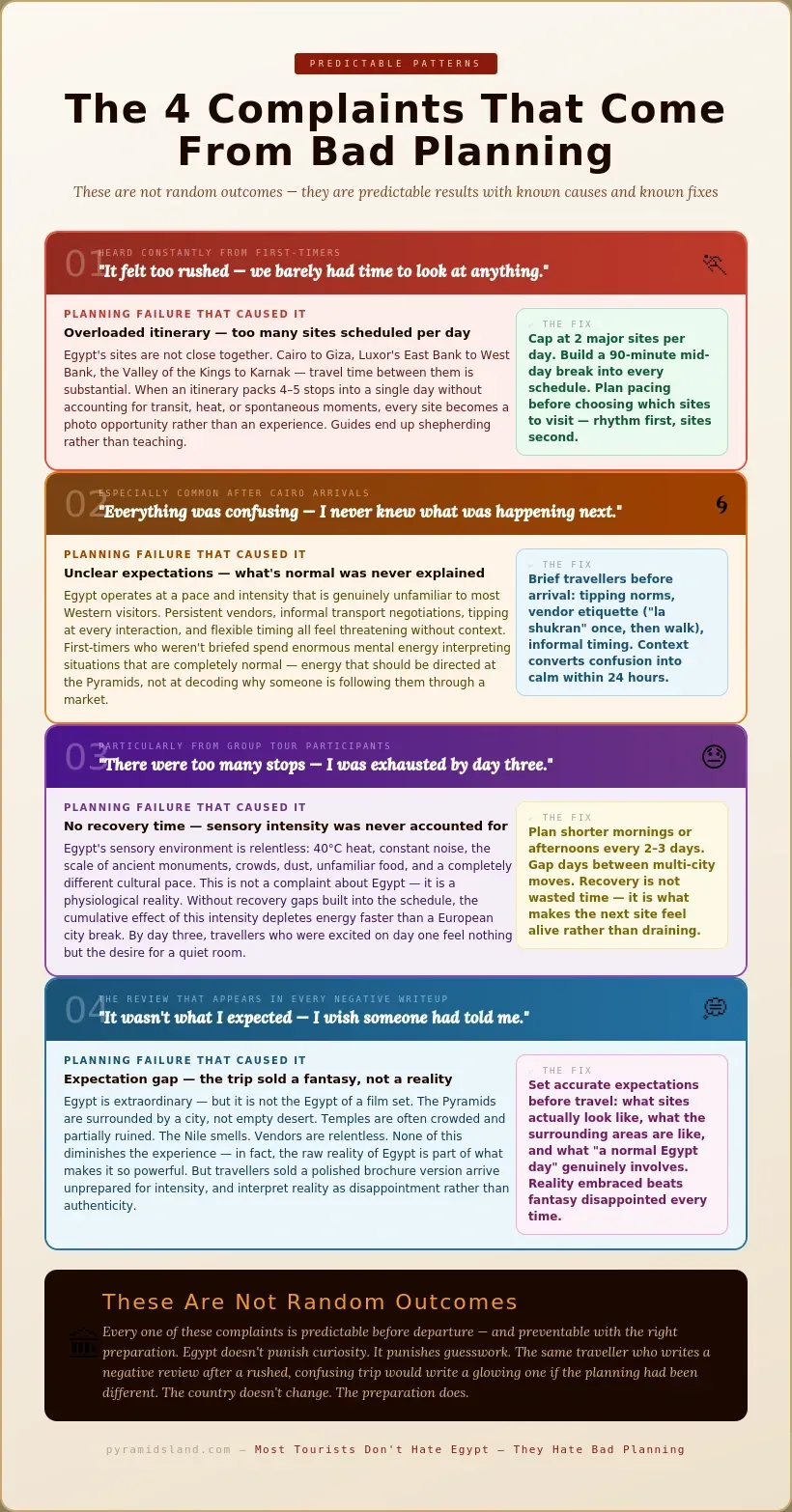
The Four Complaints That Repeat — Decoded
Negative reviews of Egypt cluster around the same four themes. I have watched each one form in real time. Here is what they mean.
"It Was Too Aggressive."
This is the most common complaint and the most misunderstood.
What the traveler experienced: being approached by vendors, taxi drivers, and self-appointed helpers more frequently and more directly than expected.
What actually happened: they entered a tourist environment with no pre-arranged services, no guide, and no clear sense of who was responsible for what. In Egypt, an unaccompanied tourist at a major site is visually obvious — and visibility invites offers.
When I walk through Giza with travelers, vendors recognize that the group is accompanied. The dynamic changes entirely. It is not that the vendors disappear — they are still there. But the approach is different. A nod, a brief greeting, and they move on. When I see unaccompanied tourists in the same area, the interaction is longer, more persistent, because there is no social signal that this person is already being served.]
One Viator reviewer described this contrast exactly: they watched other visitors being repeatedly approached at the pyramids, while their own experience was completely smooth. The only difference was a guide.
The "aggression" is not the country. It is the absence of a buffer.
"Everything Felt Like a Scam"
This one is painful because Egypt is one of the most hospitable countries in the world. But the feeling was real for the travelers who experienced it.
In nearly every case, this happens to travelers who booked cheap, commission-based tours. Negative reviews on competing Viator listings describe it with specificity: travelers taken to "locations clearly owned by their friends," shops "not included in the itinerary," and the gradual realization that the tour was designed to deliver them to retail environments rather than historical sites.
When your tour is partly a sales funnel, every subsequent interaction feels transactional. Trust collapses — not because Egypt is untrustworthy, but because the economic structure of that specific tour was designed around commission.
Here is the test: travelers who book transparent tours — where there are no mandatory shopping stops, and the guide works on a fixed daily rate, not commission — almost never describe this feeling.
"We Were Exhausted by Day Three"
Egypt is physically and mentally demanding. This is true. I am not going to minimize it.
In summer, I watch the energy difference between travelers I pick up at 6:30 am and the same travelers by 1 pm. The morning version is curious, engaged, and asking questions. The afternoon version — after five hours at exposed sites in 35-40°C heat — is quiet, short-tempered, and done. This is normal. This is Egypt in summer. The question is not whether fatigue happens. It is whether the itinerary was designed to manage it or ignore it.]
Travelers who report early exhaustion almost always have overloaded itineraries. Five sites in one Cairo day. Abu Simbel, the morning after a full Luxor day. No rest between the Valley of the Kings and Karnak in July.
Here is what a realistic day looks like: [ASHRAF-VERIFY: We arrive at the Valley of the Kings before 7 am. We spend two to two and a half hours in three tombs, chosen based on the current rotation. We drive to Karnak — but not immediately. We stop for a cold drink and a rest in the shade. We arrive at Karnak around 9:30, spend ninety minutes, and finish by 11 am. The afternoon is free. Two sites. Five hours. And travelers describe this as one of the best days of their life — because they had energy to feel what they were seeing.]
"It Wasn't Worth the Hassle"
This is the saddest complaint, because it comes from travelers who expected the Instagram version of Egypt and received the unfiltered version without a guide to bridge the gap.
The golden-hour pyramid photos are real. The empty temple corridors are real. The serene Nile is real. But none of these happen automatically.
That golden light at the pyramids requires arriving at a specific time — the Giza Plateau opens early, and the first tour buses from Cairo hotels don't arrive until approximately 9 am, creating a window that only travelers with pre-arranged early starts can access. The "empty temple" requires knowing that cruise ship passengers flood the Valley of the Kings between 8:30 and 10:30 am, and timing around it. The serene Nile moment requires a day that wasn't already crammed with three other exhausting stops.]
The "hassle" is the friction of unplanned logistics surrounding moments that were never set up to succeed.
What I Tell Travelers Who Ask "Is Egypt Worth It?"
Yes. Without qualification.
But I also tell them this: Egypt is not a country you can approach casually and expect to enjoy. Not because it is hostile — because it is dense. It compresses more history, sensory input, cultural complexity, and logistical demand into every day than almost any destination on earth.
Multiple travelers in online forums describe the same dual reality: "Egypt was the most difficult country I've traveled in... that being said, it was also the most amazing place I've ever been in my entire life." Both are true. The difficulty is real. The beauty is real. What determines which one you take home as your dominant memory is how the trip was designed. Timing matters too — traveling during Ramadan adds another layer of planning that separates great trips from overwhelming ones.
After twenty years, I can usually tell within the first few hours of meeting travelers whether their trip will end with "I can't wait to come back" or "I'm relieved it's over." The difference is not personality. It is preparation. The travelers who arrive with a clear first day, realistic pacing, and a guide they can trust are almost always the ones who cry at Abu Simbel, who sit in silence at Philae, who say at the end: "I didn't know travel could feel like this." The travelers who arrive with a price comparison spreadsheet and a seven-sites-per-day itinerary are the ones writing the negative reviews.]
The Invisible Infrastructure of a Great Egypt Trip
When I describe what well-planned travelers experience, it sounds like a different country. It is not. It is the same sites, the same cities, the same people. The difference is invisible — and that is the point.
Pre-tour communication. [ASHRAF-VERIFY: We contact every traveler the evening before their first day — confirming the pickup time, the driver's name and phone number, and what the next morning looks like. Across our reviews, this single five-minute touchpoint is one of the most frequently praised elements. Travelers describe it as "the moment my anxiety about Egypt disappeared." The trip hasn't started yet, but the trust has.]
Timing decisions. [ASHRAF-VERIFY: A guide who has worked these sites for years knows the windows. Karnak in the first hour after opening, when the light through the Hypostyle Hall's clerestory windows creates the effect the ancient architects designed — an effect that disappears by midday when the sun is overhead. The Giza panoramic viewpoint before 9 am, when the camel operators and photo vendors haven't yet crowded the area. The Valley of the Kings before the cruise ship wave.]
The guide as buffer. Across nearly 6,000 reviews, the word "safe" appears as a spontaneous, unprompted descriptor — not in response to a safety question, but as something travelers felt compelled to volunteer. Solo female travelers, families, older couples — they all use the same word, and they almost always attribute it to the guide's presence, not to gates or guards.
Pacing as design. [ASHRAF-VERIFY: I design every day around energy, not coverage. Two to three major sites with rest windows between them. Early starts, early finishes. The afternoon is free — not because there is nothing to see, but because a rested traveler at dinner, remembering what they saw at Karnak that morning, is worth more than an exhausted traveler checking off a fourth site they will not remember.]
Why First-Time Visitors Feel This Gap Most Sharply
Experienced travelers develop instincts. They can absorb intensity because they have navigated similar environments. A mediocre day in Egypt is manageable when you already know how to read unfamiliar dynamics.
First-time visitors have no buffer. Everything is new simultaneously — the scale of the monuments, the pace of Cairo, the heat, the social rhythm, the language. Without a structure to filter that newness, every moment requires active processing. Processing is exhausting.
This is why first-time travelers produce the most polarized reviews. And this is why our layover travelers — some with as little as seven hours in Cairo between flights — consistently report successful full-day tours when every logistical detail is pre-arranged. If the planning infrastructure works under the tightest possible constraints, it works everywhere.
Answering the Real Questions (From the Forums)
Travelers considering Egypt ask specific questions. Here are honest answers.
"Do I even need a guide, or can I do Egypt independently?"
You can do Egypt independently. Many travelers do. But the honest pattern in both our data and travel forums is this: experienced independent travelers who went to Egypt without a guide consistently say they wish they had one. Not because they couldn't manage — but because they spent their energy on logistics instead of on the experience. Multiple forum posters describe the same moment of conversion: "I would not return without the help of a tour company." These are not timid travelers. They are experienced ones who learned the hard way what Egypt demands.
"Is Egypt safe for two women traveling together?"
Yes. Both the UK FCDO and US State Department confirm that Egypt's major tourist areas are safe. Solo female travelers in our review data consistently cite the guide as the primary reason they felt secure, not physical security measures. The anxiety is understandable given media narratives. The reality, for travelers with basic structure in place, is that Egypt is welcoming and safe.
"How much should I actually pay for a tour?"
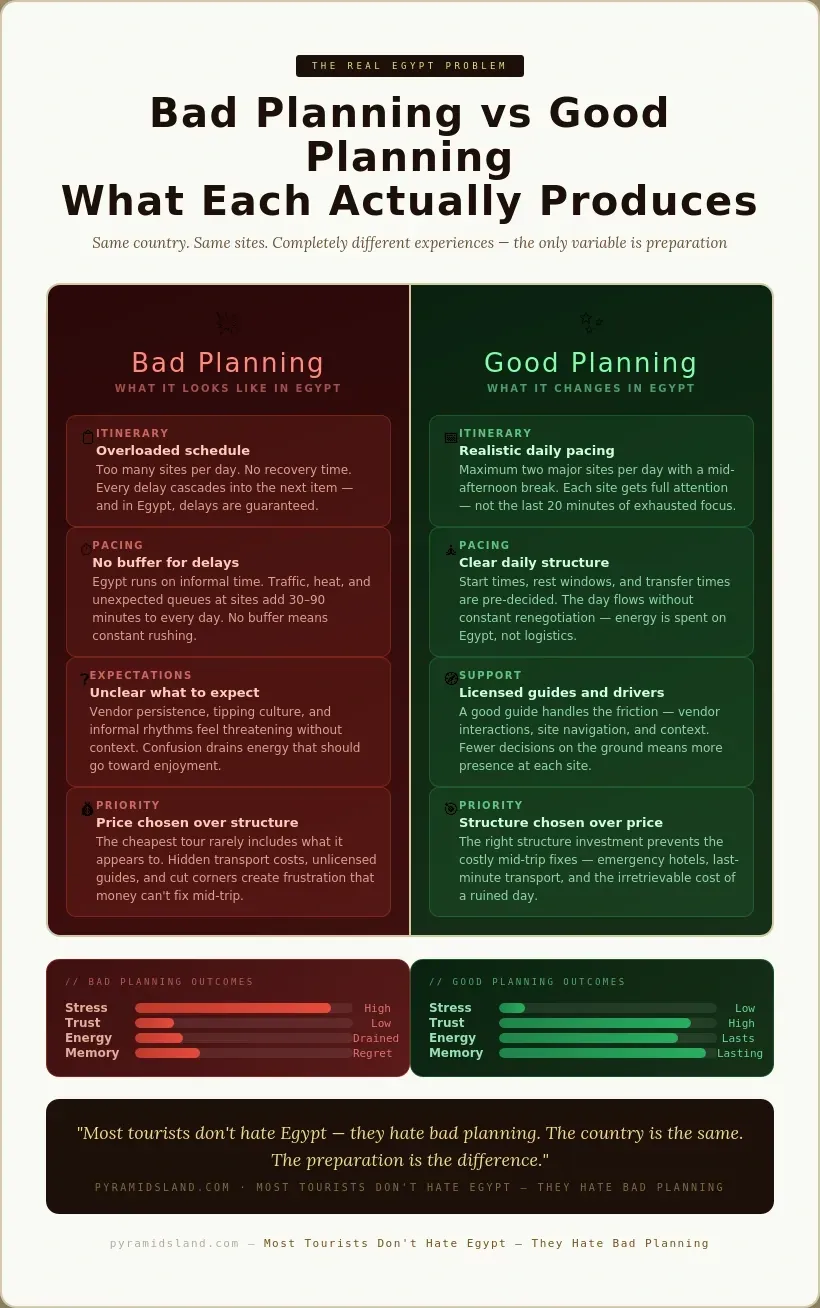
I'm not going to quote specific prices because they change. But I will say this: if a full-day guided Cairo tour costs dramatically less than comparable options, ask how. The cheapest options subsidize their price through commission stops and large groups. A well-priced private tour charges enough to deliver a dedicated guide, realistic pacing, and transparent scheduling — without inflating costs for unnecessary luxury. Compare what is included, not what it costs.]
Final Thought
If you are reading negative reviews of Egypt and feeling hesitant, understand what you are actually reading. You are reading the consequences of poor preparation applied to a destination that does not absorb it gracefully. You are not reading about a flawed country.
Egypt is extraordinary. That is not marketing — it is a consistent finding across nearly 6,000 reviewed tours over two decades of operation.
But I will also say this, because the articles that minimize Egypt's challenges do travelers a disservice: Egypt is hard. It is hot, loud, fast, dense, and socially different from what most Western travelers are used to. Accepting that — and planning for it rather than arguing against it — is the foundation of every great Egypt trip I have ever seen.
The difference between a bad Egypt trip and a great one has never been luck. It has always been the decision to prepare for the country Egypt actually is, rather than the country you imagine from photographs.
This is exactly why every Pyramids Land tour is built around structure, pacing, and clarity — because after twenty years, these are the decisions that determine whether travelers call Egypt the best trip of their life.
"See what a well-structured first trip looks like — browse our tour packages."
"Not sure yet? Start with the planning checklist."
"Or tell us about your trip — we'll answer honestly, with no obligation."
Frequently Asked Questions
Why do Egypt reviews vary so much?
Because Egypt amplifies whatever level of preparation travelers bring. It is one of the most rewarding destinations in the world and one of the least forgiving of poor planning. This combination produces extreme reviews in both directions.
Are the negative reviews about Egypt accurate?
The experiences described are usually real. But the cause, in case after case, is a planning failure — overloaded schedules, commission-based tours, no pre-arranged logistics, no guide — rather than something inherent to Egypt.
Is Egypt actually difficult to visit?
Yes, honestly — it is more challenging than most popular destinations. The heat is real, the pace is intense, and the social dynamics are unfamiliar to most Western travelers. But difficult and rewarding are not opposites. With realistic preparation, the difficulty becomes manageable and the reward is extraordinary.
Do I even need a tour, or can I do Egypt independently?
You can travel Egypt independently. But experienced independent travelers who have done both consistently report that guided travel produced a dramatically better experience — not because they couldn't manage, but because the guide freed their energy for the experience rather than the logistics.
Is Egypt safe for women traveling together?
Yes. Major tourist areas are confirmed safe by both the UK FCDO and the US State Department. Solo female travelers in our reviews consistently describe feeling secure — citing the guide's presence as the primary factor.
What is the biggest planning mistake first-time travelers make?
Treating Egypt like an easy, improvise-friendly destination. In forums and in our own experience, this is the single most common cause of negative outcomes. Egypt requires more advance coordination than most countries — and travelers who accept that consistently have better experiences.
Can a bad Egypt trip be prevented?
Almost always. The patterns in negative reviews are remarkably predictable — and every one traces back to a specific planning decision that could have been made differently.
How do I make sure my trip is positive?
Start with structure. Arrange airport transfers and a guide before arrival. Choose realistic pacing — two to three sites per day, not five. Set expectations for the heat and the social dynamics. And work with someone who knows the country well enough to design a day that manages your energy, not just your itinerary.
Sources referenced:
- Baumeister, R.F., et al. (1998). Ego depletion: Is the active self a limited resource? J. Personality and Social Psychology, 74(5). PubMed
- UK Foreign, Commonwealth & Development Office — Egypt Travel Advice
- US State Department — Egypt Travel Advisory
- Egyptian Travel Agents Association — License Verification
Ashraf Fares