You will encounter the Eye of Ra before you understand what it means. It appears on temple walls at Karnak, on amulets in the Grand Egyptian Museum, on the foreheads of royal statues, carved into tomb ceilings, and etched into jewelry that is 3,000 years old. It is one of the most reproduced images in ancient Egyptian art — and one of the most commonly confused.
The Eye of Ra is not the Eye of Horus, though the two look almost identical. It is not a generic "evil eye" or a new-age protection charm. It is a specific theological concept: the destructive, protective extension of the sun god's power, personified as a goddess, and embedded in some of the most dramatic myths in Egyptian religion.
Understanding it changes how you read temple walls.
What the Eye of Ra Actually Represents
The Eye of Ra is traditionally identified as the right eye of the sun god — the solar eye — though the distinction between right and left, solar and lunar, evolved over time and was not always rigid in Egyptian texts. By the New Kingdom, the convention had largely settled: the right eye belonged to Ra (the sun), the left to Horus (the moon).
What remained consistent across all periods was the Eye of Ra's function: an extension of Ra's will that could act independently, sometimes with devastating consequences.
What the Symbol Looks Like
The Eye of Ra takes two visual forms in Egyptian art, and you will see both across every temple and museum in Egypt.
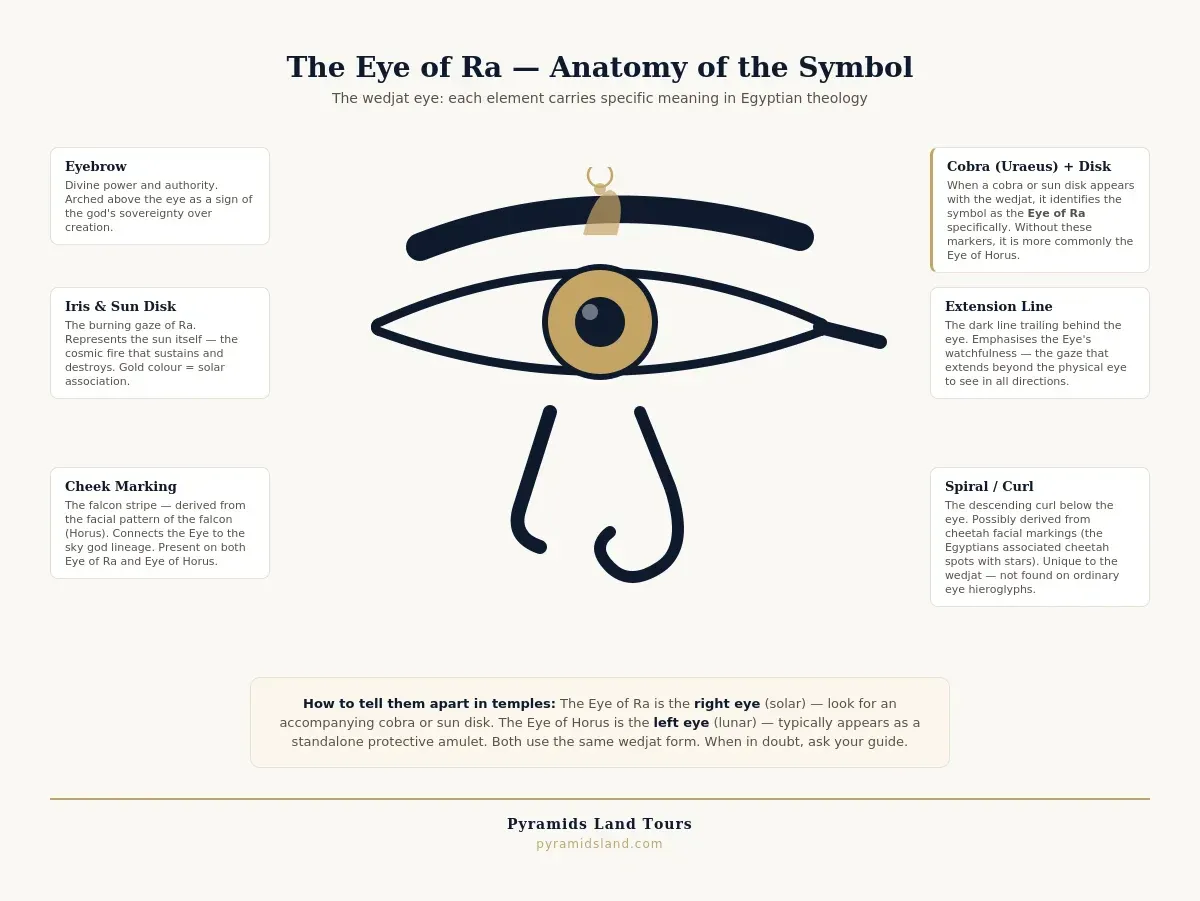
The first is the wedjat eye — a stylized human eye with distinctive markings: a dark line extending behind the outer corner of the eye, a curved cheek marking below (resembling the facial pattern of a falcon), and a spiral or curling line descending from the lower lid. This is the form most people recognize.
Eye of Ra vs. Eye of Horus
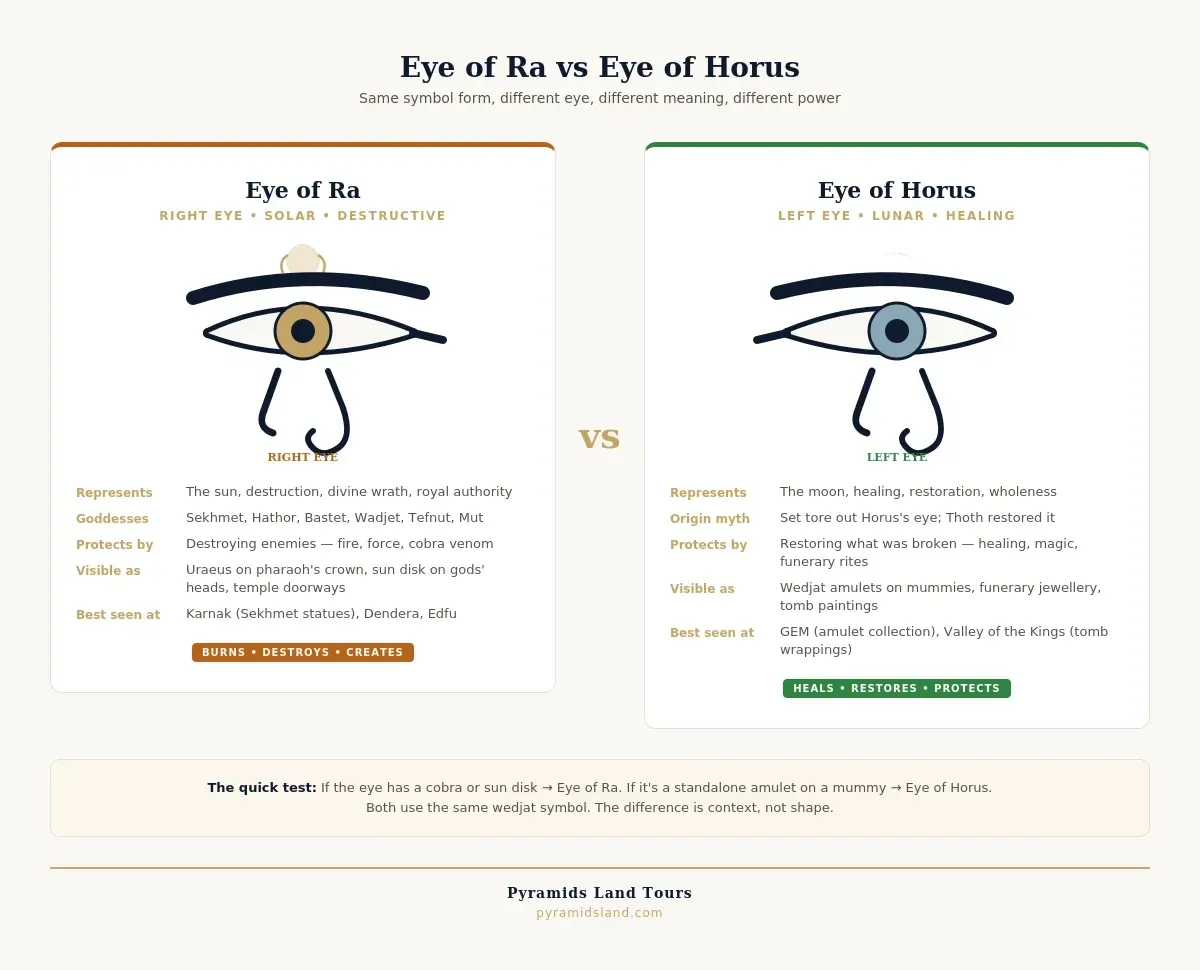
Both use the same wedjat symbol. The difference is context. When the wedjat appears with a cobra or sun disk, it is the Eye of Ra. When it appears alone as a protective amulet on a mummy, it is more commonly the Eye of Horus.
The second form is the sun disk — a yellow or red circular emblem, sometimes depicted as a flat disk, sometimes as a convex sphere, often encircled by one or two rearing uraeus cobras. This disk appears on the heads of Ra, Horus, Hathor, Sekhmet, and other solar-associated deities. It is one of the most common symbols in all of Egyptian art.
The disk is not merely a hat or crown — it is the Eye of Ra in its cosmic form. In some depictions, the solar barque (the boat carrying Ra through the sky) is shown enclosed within the disk, and in others, Ra himself sits inside it. When you see a god or goddess wearing a disk on their head, you are looking at the Eye of Ra.
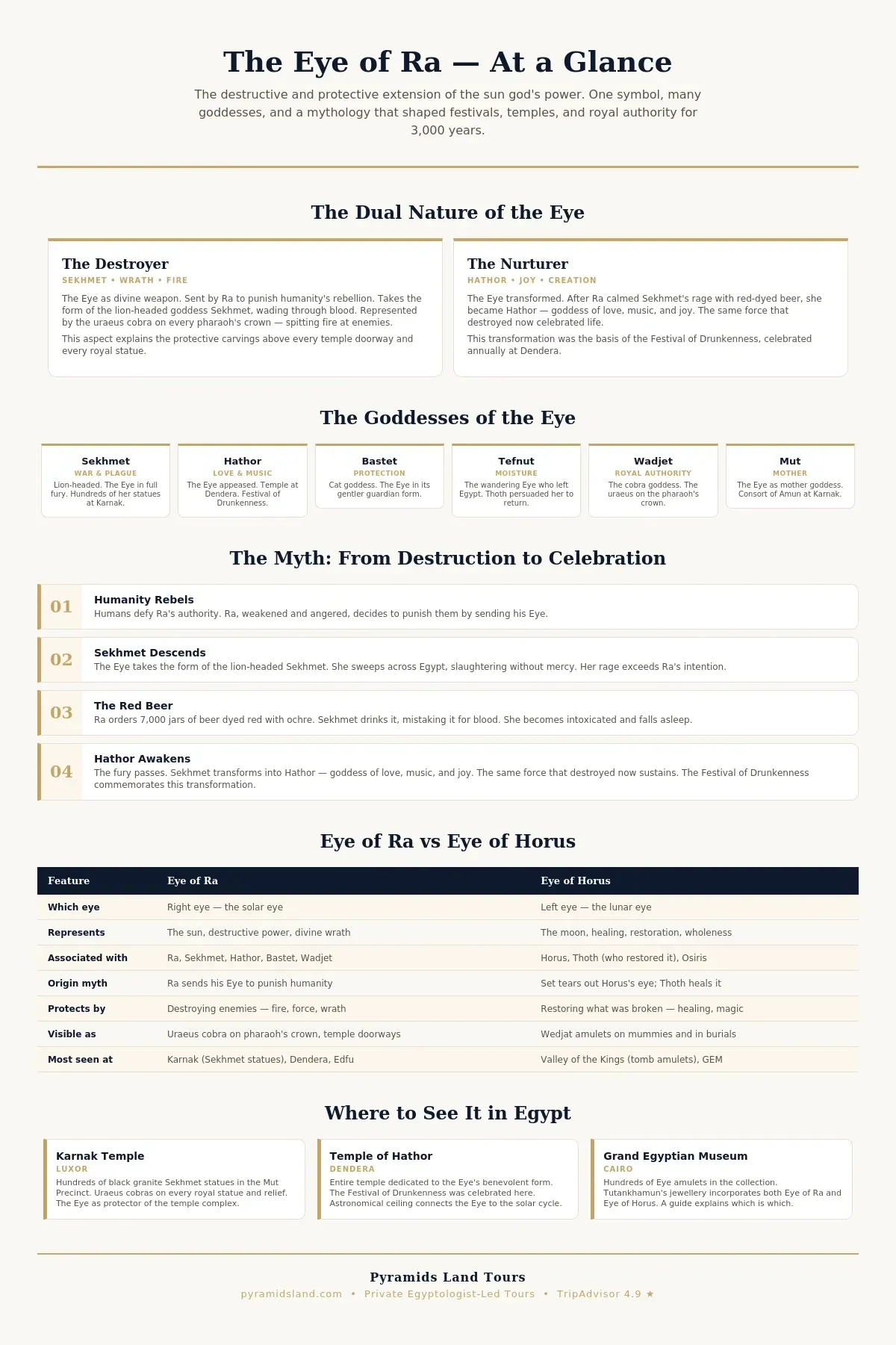
In Egyptian theology, the Eye served two roles simultaneously. It was a protective force — the burning gaze of the sun that watched over creation, defended the pharaoh, and destroyed the enemies of cosmic order. And it was a creative force — the heat and light that sustained life along the Nile. Without the Eye's warmth, crops would not grow, the Nile flood would not come, and Egypt would die. The same solar intensity that could scorch enemies also ripened grain and warmed the earth into fertility.
One creation myth makes this life-giving power explicit: Ra wept, and the tears that fell from his Eye became the first human beings. The Egyptians noted the wordplay — remyt (tears) and remet (people) — and saw it as proof that humanity was born from the Eye's creative force, not from clay or breath as in other cultures' origin stories. The Eye did not merely protect life. It generated it.
This is why the Eye was associated with goddesses of both war (Sekhmet) and love (Hathor) — destruction and creation were not contradictions but two expressions of the same energy. The Egyptians did not separate the sun that burns from the sun that gives life. They were the same Eye.
The Eye was not abstract. The Egyptians personified it as a goddess — and not just one. Depending on the period, the temple, and the myth being told, the Eye of Ra could take the form of Sekhmet (the lion-headed goddess of war and plague), Hathor (the goddess of love, music, and joy), Bastet (the cat goddess of protection), Tefnut (goddess of moisture), Mut (the mother goddess), or Wadjet (the cobra goddess of Lower Egypt).
This is not confusion. It is theology. The Egyptians understood the Eye as a single divine concept that manifested through different goddesses depending on context — wrathful when provoked, nurturing when appeased, always watching.
The Uraeus: The Eye on the Pharaoh's Forehead
The most visible form of the Eye of Ra in royal iconography is the uraeus — the rearing cobra worn on the forehead of every pharaoh's crown. This is not decoration. It is the Eye of Ra in its most concentrated form: a divine weapon mounted on the ruler's brow, ready to spit fire at anyone who threatens the king or the cosmic order he represents.
The uraeus appears on every royal statue you will see in Egypt — from the colossal Ramesses II at the GEM entrance to the gold death mask of Tutankhamun. It appears on every type of crown: the white crown of Upper Egypt, the red crown of Lower Egypt, and the double crown of unified Egypt. It is carved above temple doorways, protecting the sacred space within. It lines the base of pyramids, guarding the pharaoh's body inside.
The cobra goddess Wadjet — patron of Lower Egypt — was the deity most directly associated with the uraeus. But the uraeus itself was understood as the Eye of Ra made physical: the sun god's burning gaze, channeled through the king, pointed at the enemies of Ma'at.
When Thutmose III systematically defaced the monuments of his stepmother Hatshepsut after her death, her images were chiseled away, her cartouches erased, and her female figures reshaped into male ones. The defacement was not random vandalism — it was theological erasure. By destroying her royal images, including the uraeus-crowned representations of her as pharaoh, Thutmose denied her the divine authority that the cobra represented. At Deir el-Bahri, you can still see the scars where her name and image were cut from the stone.
You will see the uraeus hundreds of times during a single day in Luxor or Cairo. Once you know what it means, every pharaoh's statue tells you something about the relationship between the king and the sun god.
The Sun Disk: The Eye in Cosmic Form
The uraeus is the Eye at human scale — on the king's forehead. The sun disk is the Eye at cosmic scale — the burning sphere that crosses the sky each day.
In Egyptian art, the sun disk is depicted as a red or golden circle, often flanked or encircled by one or two uraeus cobras. It appears on the heads of Ra, Ra-Horakhty, Hathor, Sekhmet, and other solar deities. Four uraei sometimes surround Ra's solar barque — collectively called "Hathor of the Four Faces" — representing the Eye's vigilance in all four directions simultaneously.
The disk was not merely symbolic. Egyptians sometimes described it as Ra's physical body — the visible form of the god as it moved across the sky. In some reliefs, the solar barque (the boat carrying Ra and his divine entourage) is shown inside the disk, as if the sun itself were a vessel. In others, Ra sits enthroned within the disk while the uraei spit fire outward at the forces of chaos.
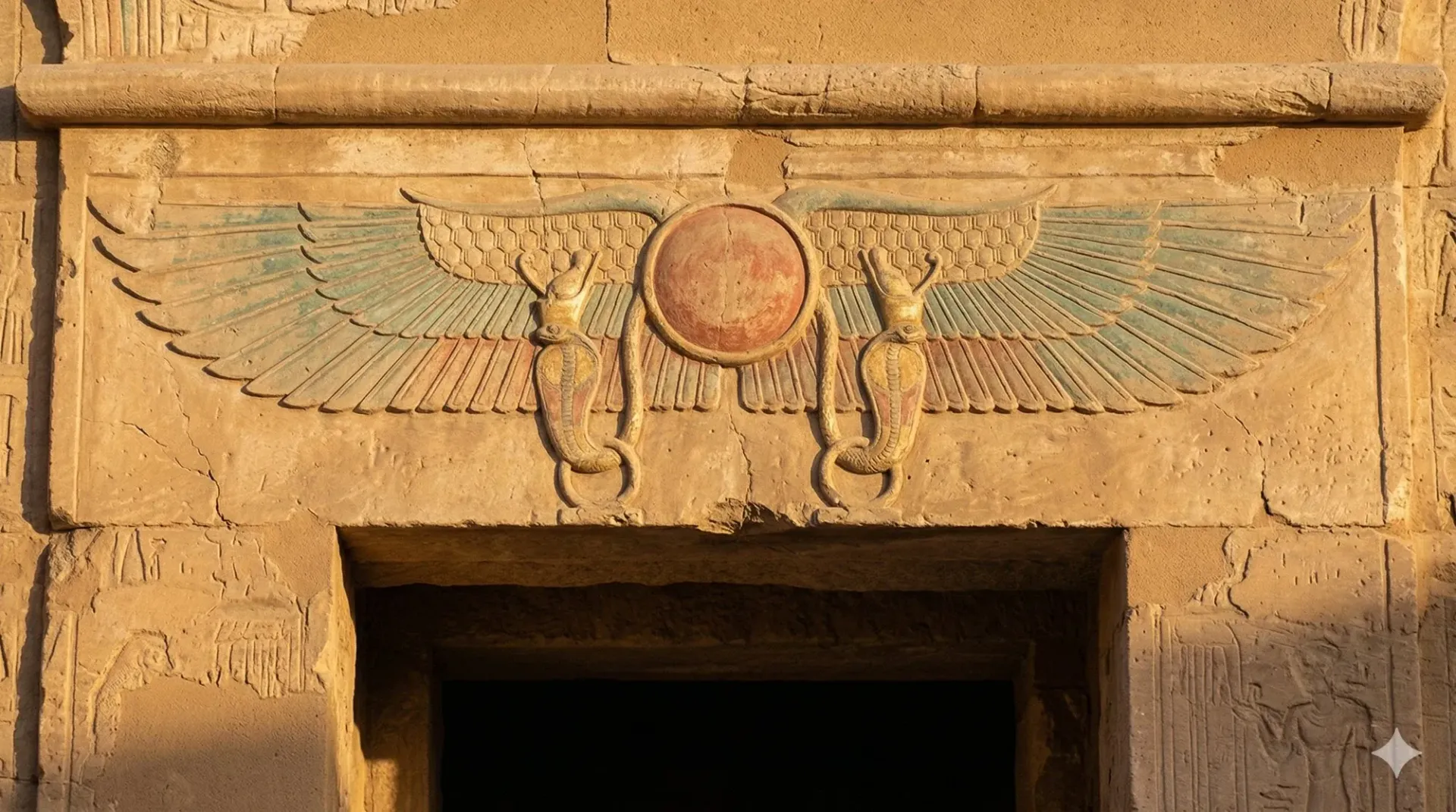
This is what you see when you look at the ceiling paintings in the Valley of the Kings, or the carved reliefs above temple doorways at Karnak and Edfu: the disk flanked by cobras is not a decorative motif. It is the Eye of Ra — the sun god's power made visible, burning above the sacred space, protecting everything beneath it.
→ Ancient Egyptian Symbols — the complete guide · Queen Hatshepsut — her reign and her erasure
Private Karnak & Luxor Temple Tour
Walk through the temples where these symbols were carved, with a licensed Egyptologist who can read the walls.
The Mythology: The Rage of the Eye
The most important myth associated with the Eye of Ra explains both its destructive nature and its transformation — and it was celebrated in Egyptian festivals for centuries.
The story varies across sources, but the core narrative is consistent:
Humanity rebelled against Ra. In response, Ra sent his Eye — in the form of his daughter, the lion-headed goddess Sekhmet — to punish them. Sekhmet descended upon the earth in a fury, slaughtering humans and wading through blood. She could not be stopped. Her rage exceeded Ra's intention. She was not punishing rebellion — she was annihilating the species.
Ra, seeing the destruction, devised a plan. He ordered 7,000 jars of beer to be dyed red with ochre so that it resembled blood. The mixture was poured across the fields where Sekhmet would attack next. She drank it, mistaking it for blood, became intoxicated, and fell asleep. When she awoke, her fury had passed. She transformed from Sekhmet — the destroyer — into Hathor — the goddess of love, music, and joy.
This myth is not just a story. It was the basis of the Festival of Drunkenness (Tekh Festival), one of the most remarkable religious celebrations in ancient Egypt. Held annually — most prominently at the Temple of Hathor in Dendera and the Temple of Mut at Karnak — the festival re-enacted the moment the Eye's rage was transformed into joy.
The ritual was structured and deliberate. Participants drank large quantities of beer dyed red with ochre or pomegranate juice, replicating the mixture that calmed Sekhmet. They danced, played sistrums (the ritual rattle sacred to Hathor), and sang hymns. The drinking was not recreational excess — it was a theological practice. The goal was to reach a state of intoxication that mirrored Sekhmet's transformation: passing through frenzy into peace, emerging on the other side as Hathor.
After the drinking, participants slept — and were then awakened by drumming and music, symbolizing the goddess's return to consciousness in her benevolent form. The moment of waking was the climax of the festival: the transition from destruction to love, re-enacted collectively by an entire community.
Inscriptions at Dendera describe the festival in detail, including the quantities of beer prepared, the musicians employed, and the processions that accompanied the ritual. The temple's hypostyle hall — with its Hathor-headed columns and astronomical ceiling — was the setting for these ceremonies. When you visit Dendera today, you are standing in the room where the Festival of Drunkenness took place.
The same divine force that destroys is the same force that creates joy. Sekhmet and Hathor are not opposites — they are two states of the same Eye.
This duality — wrath and love held in the same symbol — is central to how the Egyptians understood divine power.
The Wandering Eye
A second major myth cycle involves the Eye leaving Egypt entirely. In various versions, the Eye — personified as Tefnut or another goddess — departs for a distant land (Nubia, Libya, or Punt), taking the form of a wild, uncontrollable lioness. Egypt suffers immediately in her absence: the sun weakens, the land dries, order falters, and the balance of Ma'at begins to unravel.
The gods send a messenger to retrieve her — most often Thoth , the god of wisdom, sometimes accompanied by Shu , the god of air. Thoth does not use force. He uses storytelling, flattery, humor, and reasoned argument — a divine diplomat persuading a raging lioness to come home. In some versions, Thoth takes the form of a baboon or an ibis, approaching the goddess carefully, telling her fables about the consequences of abandoning Egypt and the rewards of returning.
Gradually, the goddess calms. As she journeys back toward Egypt, she transforms — shedding her lioness fury, becoming first a wild cat, then the gentle Hathor. Along the Nile route, communities celebrate her return with music, dancing, wine, and offerings. Shrines built along the riverbank contain images of dwarfs, animals, and musicians rejoicing at the goddess's homecoming — processional art you can still see at Philae, Dendera, and the temple of Montu at Medamud.
This myth was the basis for New Year festivals and celebrations of the annual Nile flood, which the Egyptians associated with the Eye's return and the restoration of fertility. The flood — the most important natural event in the Egyptian year — was understood not as weather but as the goddess coming home, bringing moisture and abundance with her. The myth connected cosmology, agriculture, and ritual into a single narrative arc.
The Eye in the Underworld: Every Night, Every Tomb
The Eye of Ra was not only active in the world of the living. It played a critical role in the underworld — and this is what you see painted on the walls of the Valley of the Kings.
The concept of the Eye as a protective force in the afterlife is ancient. The earliest references appear in the Pyramid Texts — spells carved inside Old Kingdom pyramids at Saqqara (c. 2400–2300 BC), the oldest religious literature in the world. These texts invoke the Eye to protect the dead pharaoh and to destroy the forces of chaos in the underworld. The Coffin Texts of the Middle Kingdom (c. 2000–1700 BC) expanded the Eye's role, making its protection available to non-royal Egyptians for the first time — the democratization of the afterlife extended to the democratization of the Eye's power.
By the New Kingdom, the Eye's underworld role was fully developed in elaborate illustrated texts painted on tomb walls. According to the Amduat (the text describing "what is in the underworld"), the sun god Ra traveled through the Duat every night in a barque, passing through twelve hours of darkness before being reborn at dawn. The journey was not passive. Each hour brought dangers — demons, gates, lakes of fire, and above all, the serpent Apophis (also called Apep), the embodiment of chaos, who attempted to swallow Ra and prevent the sun from rising.
The Eye of Ra was the weapon that defeated Apophis. In tomb paintings, you see the Eye — sometimes depicted as a fiery disc, sometimes as the uraeus cobra — destroying the serpent, cutting it apart, burning it into submission. This was not a one-time event. It happened every single night. The sun rising each morning was proof that the Eye had won again.
This is why the tombs of the Valley of the Kings are covered with these scenes. The pharaoh, buried inside the mountain, was joining Ra on this nightly journey. The painted walls were not decoration — they were maps, spells, and weapons, ensuring the pharaoh (and through him, the sun) would survive the darkness and emerge reborn.
When you stand inside the tomb of Seti I or Ramesses VI and see the serpent being destroyed by fire, you are looking at the Eye of Ra in action — doing the job it was created to do. The Litany of Ra , another funerary text found in the tombs of Seti I, Ramesses II, and other New Kingdom pharaohs, contains 75 invocations of Ra in different forms — many referencing the Eye and its protective power. The text was inscribed at the entrance to the tomb, the first thing the pharaoh's soul would encounter on the journey into the underworld. It was a prayer, a weapon, and a map, all invoking the Eye.
→ Valley of the Kings Guide — which tombs show these scenes · Ancient Egyptian Religion — the afterlife journey in full
The Eye in Daily Life: Amulets, Homes, and Ordinary Protection
The Eye of Ra was not reserved for pharaohs and temples. Ordinary Egyptians used it too.
Amulets bearing the Eye of Ra were worn by men, women, and children as personal protection. These were small — often no larger than a thumbnail — carved from faience, carnelian, lapis lazuli, or gold. They were worn as necklaces, sewn into clothing, and placed in mummies' wrappings. The GEM's amulet collection contains hundreds of examples, and a guide can show you the subtle differences between Eye of Ra and Eye of Horus amulets (the cobra or solar disc markings distinguish them).
Household protection extended the Eye's power beyond the body. Archaeological evidence from New Kingdom towns (including Deir el-Medina, the workers' village near the Valley of the Kings) shows that small clay models of uraei — the Eye of Ra in cobra form — were placed around the perimeters of houses. Some had small bowls in front of their mouths for burning fuel, creating tiny protective fires. Magical texts describe these models as having "fire in their mouths" — the Eye of Ra, guarding a family while they slept.
This is what makes the Eye of Ra more than a royal or priestly symbol. It was democratic. A pharaoh had the uraeus on his crown. A farmer had a clay cobra at his door. Both invoked the same divine force.
Eye of Ra vs Eye of Horus: The Actual Difference
These two symbols look nearly identical — a stylized human eye with distinctive markings below. Visitors encounter both in Egyptian temples and museums, and the confusion is understandable. Here is how they differ:
The Eye of Ra is the right eye — the solar eye. It represents the sun, destructive power, divine authority, and the wrath of Ra. It is personified as a goddess (Sekhmet, Hathor, Bastet). It is associated with fire, the uraeus cobra, and the pharaoh's protection through force.
The Eye of Horus (the Wedjat) is the left eye — the lunar eye. It represents the moon, healing, restoration, and protective magic. It originates from the myth of Horus and Set: during their battle for the throne of Egypt, Set tore out Horus's left eye. Thoth restored it, and the healed eye became a symbol of wholeness and recovery. It was the most common amulet in Egyptian burial practices — placed on mummies to protect the dead.
Ra's Eye burns. Horus's Eye heals. Ra's Eye destroys enemies. Horus's Eye restores what was broken. Both protect — but through opposite mechanisms.
The two were sometimes used interchangeably in later periods, and some texts blur the distinction. But in the temples and tombs you visit, understanding which eye you are looking at — and what it is doing — adds a layer of meaning that most visitors miss entirely.
| Feature | Eye of Ra | Eye of Horus |
|---|---|---|
| Which eye | Right — the solar eye | Left — the lunar eye |
| Represents | The sun, destruction, divine wrath | The moon, healing, restoration |
| Associated with | Ra, Sekhmet, Hathor, Bastet, Wadjet | Horus, Thoth, Osiris |
| Origin myth | Ra sends his Eye to punish humanity | Set tears out Horus's eye; Thoth heals it |
| Protects by | Destroying enemies — fire, force, wrath | Restoring what was broken — healing, magic |
| Visible as | Uraeus cobra on pharaoh's crown, temple doorways | Wedjat amulets on mummies and in burials |
| Best seen at | Karnak, Dendera, Edfu | Valley of the Kings, GEM |
→ Ancient Egyptian Religion — the full belief system
Myth vs Reality: What the Internet Gets Wrong
The Eye of Ra is one of the most searched ancient symbols on the internet — and one of the most consistently misrepresented. Here is what you will read online, what is actually true, and why the difference matters when you are standing inside a temple.
"The Eye of Ra is evil." It is not. The Eye is protective and creative. It can be ferociously destructive — Sekhmet's rampage is real in the mythology — but that destruction serves cosmic order, not malice. The Eye destroys the enemies of Ma'at (truth, balance, justice). It is wrathful, not evil. Calling it evil is like calling a fire alarm dangerous because it is loud.
"The Eye of Ra and the Eye of Horus are the same thing." They use the same wedjat symbol, but they represent opposite forces: Ra's Eye burns, Horus's Eye heals. At the GEM, your guide can show you both Tutankhamun's jewelry and explain why the boy king needed both destruction and restoration for his journey into the afterlife.
"The Eye of Ra is on the US dollar bill." It is not. The All-Seeing Eye above the pyramid on the Great Seal of the United States is a Masonic and Christian symbol representing divine providence. It has no connection to the Eye of Ra or the Eye of Horus, despite the pyramid beneath it. This is the most common misconception, repeated endlessly online and in tattoo parlors.
"The Eye of Ra is a curse." There is no curse tradition associated with the Eye of Ra in any period of Egyptian religion. This idea comes from modern horror fiction and video games, not from ancient texts. The Eye was invoked for protection — pharaohs placed it on their crowns, ordinary Egyptians wore it as jewelry, and families placed clay cobra models at their doors. You do not put a curse on your own front door.
"Walking around the scarab at Karnak seven times is an ancient Egyptian ritual." It is a modern tourist tradition. The granite scarab at the Sacred Lake was dedicated by Amenhotep III, but there is no ancient text prescribing that you walk around it for luck. Your guide will tell you this — and then explain what the scarab actually symbolized (the sun god Khepri, the dawn, and daily renewal), which is more interesting than the invented ritual.
This is the difference between visiting Egypt with a guide and visiting with a guidebook. A guidebook repeats the myths. A guide corrects them.
Where You See the Eye of Ra in Egypt
The Eye of Ra is not in a single location. It is everywhere — but it is most visible at these sites:
Karnak Temple, Luxor. The uraeus cobra appears on virtually every royal statue and relief in the complex. The Eye of Ra is carved above doorways as a protective symbol. The Sekhmet statues in the Mut Precinct — hundreds of black granite lion-headed figures — represent the Eye in its most fearsome form.
Temple of Hathor, Dendera. The entire temple is dedicated to Hathor — the Eye of Ra in her benevolent form. The Festival of Drunkenness was celebrated here. The astronomical ceiling in the hypostyle hall, showing the sky goddess Nut, connects the Eye to the solar cycle. This is the single best place in Egypt to understand the Sekhmet-to-Hathor transformation.
Grand Egyptian Museum, Cairo. The amulet collection includes hundreds of Eye of Ra and Eye of Horus amulets — many small enough to hold in your palm, each carved with extraordinary precision. The Tutankhamun galleries contain jewelry incorporating both eyes. A guide can point out which is which and explain the difference in context.
Valley of the Kings, Luxor. The tomb paintings include scenes from the Amduat and other funerary texts where the Eye of Ra accompanies the sun god through the underworld at night, destroying the serpent Apophis (the embodiment of chaos) to ensure the sun rises again each morning.
Temple of Edfu. The reliefs depicting the battle between Horus and Set include prominent use of both eye symbols. The temple texts describe the Eye of Ra's role in defending cosmic order.
Philae Temple, Aswan. The myth of the returning Eye is referenced in the Ptolemaic decorative program. Images of rejoicing figures along the processional route celebrate the goddess's homecoming.
→ Karnak Temple Guide · Valley of the Kings Guide · Grand Egyptian Museum Guide
Why This Matters When You Visit
Without the Eye of Ra, the uraeus on every pharaoh's forehead is just a decorative cobra. The hundreds of Sekhmet statues at Karnak are just lion-headed figures. The astronomical ceiling at Dendera is just a painted sky. The amulets in the GEM are just small carved stones.
With the Eye of Ra, everything connects. The cobra is a weapon. Sekhmet is a warning. Dendera is a celebration of transformed rage. The amulets are personal protective devices that ordinary Egyptians carried because they believed the Eye's power was real and accessible.
This is what changes when you visit Egypt with an Egyptologist guide who knows the material — not someone who memorized a script, but someone who can stand in front of 730 Sekhmet statues at Karnak and explain why they are there, what they represent, and why a pharaoh commissioned two for every day of the year. The temples stop being ruins and start being readable.
Frequently Asked Questions
Is the Eye of Ra evil?
Can you wear the Eye of Ra as jewellery?
What does the Eye of Ra protect against?
Is the Eye of Ra the same as the third eye?
Why are there so many goddesses associated with the Eye of Ra?
- Richard H. Wilkinson, The Complete Gods and Goddesses of Ancient Egypt (Thames & Hudson, 2003) — the standard reference on Egyptian deities and their iconography, including the Eye of Ra's multiple goddess manifestations.
- Geraldine Pinch, Egyptian Mythology: A Guide to the Gods, Goddesses, and Traditions of Ancient Egypt (Oxford University Press, 2004) — accessible scholarly overview of the myths discussed in this article.
- James P. Allen, Middle Egyptian: An Introduction to the Language and Culture of Hieroglyphs (Cambridge University Press, 2014) — includes discussion of the wedjat symbol in hieroglyphic context.
- Pyramid Texts, particularly Utterances 246, 261, and 517 — the earliest surviving references to the Eye of Ra's protective and destructive functions (c. 2400 BC).
- Erik Hornung, The Egyptian Amduat: The Book of the Hidden Chamber (Living Human Heritage Publications, 2007) — the definitive translation of the underworld text depicted in the Valley of the Kings tombs.