
Everything You Need to Know About Cairo’s Khan el-Khalili Bazaar
About
Rewind almost 700 years and Cairo’s Khan el-Khalili Bazaar was the Mamluk equivalent of a modern shopping mall – except vendors travelled by camel from all over Africa to trade their wares, and sold them from stone-cut alcoves ringed around a columned courtyard. Today Khan el-Khalili sprawls across a labyrinthine network of courtyards, souks and alleyways in the capital’s historic center and tempts visitors from across the world with its trove-like collection of souvenirs and crafts. It is a veritable feast for the senses – a place whose colors, sounds and scents both transport you back in time and connect you to the people of modern Cairo.
History of Khan el-Khalili
By the end of the 14th century, Cairo was the capital of the Mamluk empire and construction projects were underway to regenerate the city after the devastating effects of the Black Death. As part of this project, the sultan’s Master of Stables – a man named Jaharkas el-Khalili – ordered the demolition of a mausoleum that had previously housed the remains of the Fatimid caliphs and their families. The bones of these erstwhile rulers were unceremoniously thrown onto the city’s rubbish dumps and in the newly created space a khan, or caravanserai, was built. Caravanserais were inns for travelling merchants, where they could sleep, stable their horses and camels, and store or sell their goods.
By the 15th century, Khan el-Khalili was the city’s primary center for foreign traders, with Cairenes coming to browse wares imported from across Africa and the Mediterranean. In the early 16th century the khan was demolished and rebuilt by another Mamluk sultan, who added an adjacent souk with two monumental gates. From then on, the khan continued to expand until there were more than 20 individual courtyard caravanserais connected by secondary souk streets. This vast, interconnected trading center is what awaits visitors to Khan el-Khalili today.
What to See and Do
Architecture
As the most famous market in Cairo, Khan el-Khalili deserves a spot on every visitor’s itinerary although many locals shop there as well. As you move through the maze-like streets, keep an eye out for original architectural elements amidst the modern additions and renovations; a vaulted ceiling or archway here, a vintage mosaic there, or a pair of exquisitely carved wooden doors. Notably, the two monumental gates from the 16th-century expansion still stand. The bazaar is a photographer’s paradise, although most people come here for one main reason – to shop.
Shopping
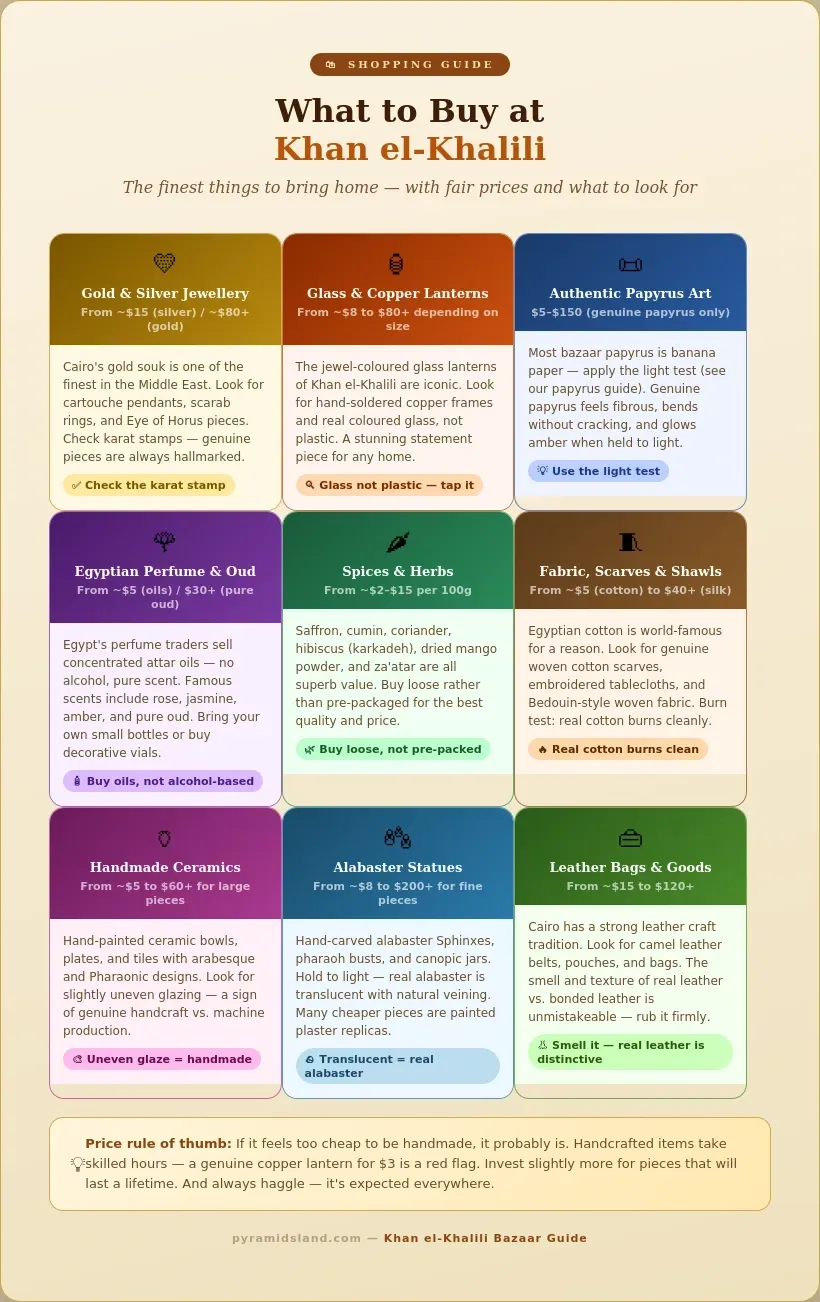
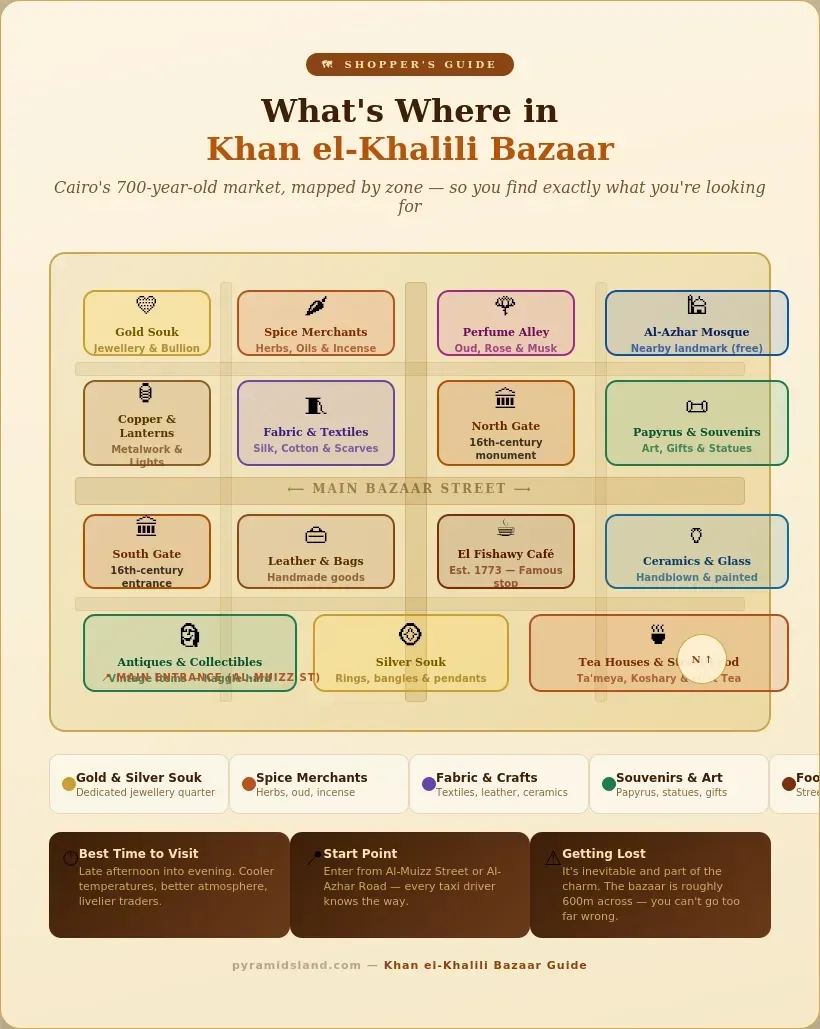
At Khan el-Khalili, you will find every kind of souvenir imaginable, from ubiquitous toy camels and model pyramids to products from artisan workshops whose crafting techniques have remained unchanged for hundreds of years. Just imagine: glass lanterns in a myriad jewel-like shades, swathes of exotic fabric, and jewelry crafted by master gold and silversmiths. If you have fallen in love with Egyptian cuisine during your time in the country, be sure to visit the spice merchants to stock up on the essential ingredients you need to recreate your favorite dishes back home. There are distinct areas for gold, copper, and spices. Still, everything else is jumbled together in a gloriously haphazard fashion so that a trip through Khan el-Khalili can feel a lot like stumbling upon Aladdin’s cave.
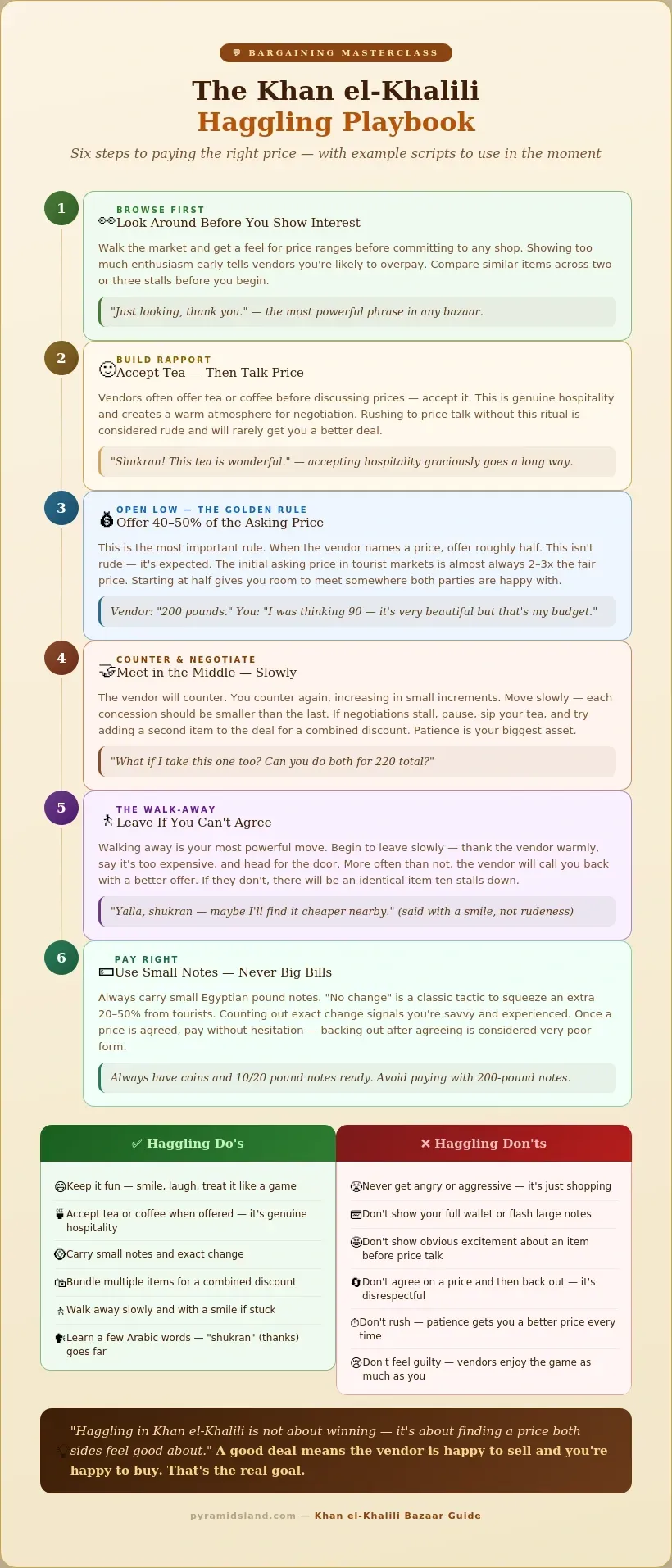
Don’t forget that haggling is expected everywhere in Egypt, and Khan el-Khalili is no exception. Bring your best sense of humor and treat the back-and-forth as part of the experience. If you’re not sure how to begin, a good rule of thumb is to offer half the vendor’s initial asking price, then negotiate from there until you settle on a price both parties are happy with.
You may like to read Egypt Shopping Guide
Dining
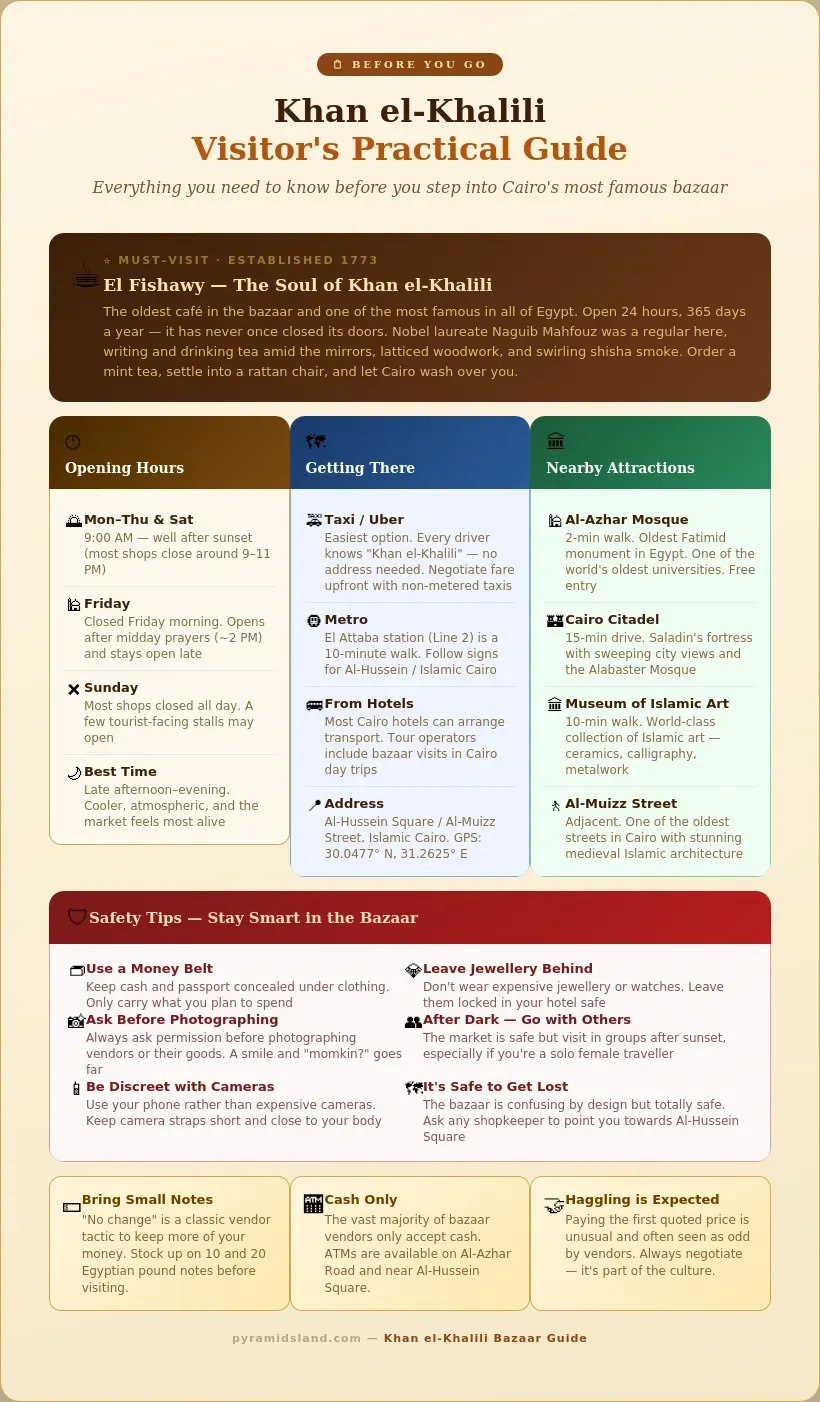
Shopping (and haggling) can be hungry work, but fortunately Khan el-Khalili is dotted with authentic Egyptian restaurants and street food stalls. Stop for a paper bag filled with piping hot ta’meya, or Egyptian falafel; or opt for a bowl of savory koshary. Of the market’s many coffeehouses, the most famous is El Fishawy. Established in 1773, it’s the oldest café in the bazaar and claims to have been one of the favorite haunts of Egyptian writer and Nobel laureate Naguib Mahfouz. Chanel his creativity while smoking a shisha pipe and writing about your Cairo experiences in your own travel diary.
How to Visit Khan el-Khalili
As long as you keep your wits about you, it is perfectly safe to visit Khan el-Khalili independently (although you may feel more comfortable if you have had previous experience in the colourful but chaotic markets of North Africa). Getting there is easy, since both taxis and Uber operate in the capital and every driver in the city knows the way to Khan el-Khalili Bazaar. Shops and stalls tend to open at around 9 a.m. and close well after sunset, although most are closed on Friday mornings and throughout the day on Sundays. There are many other points of interest to visit in the surrounding area, including Al-Azhar Mosque (the oldest Fatimid monument in Egypt), the Cairo Citadel and the Museum of Islamic Art.
Alternatively, you may wish to explore the bazaar with a local guide. With their insider knowledge at your disposal, you will be able to navigate more quickly to the best shops and can ask for help haggling in Egyptian. You also won’t need to worry about getting lost, or staying safe in the crowd. Pyramids Land Tours includes a visit to Khan el-Khalili on many of its Cairo day trips. Depending which one you choose, you’ll also have the chance to explore sites like the Egyptian Museum, the Citadel, the Hanging Church and the Pyramids of Giza. Best of all, you’ll be transported in between attractions in an air-conditioned minivan.
Top Tips for the Best Experience
Although Khan el-Khalili is considered safe, you should take the same precautions here that you would in the crowded areas of any big city. Pickpockets can be an issue, so carry your money and any important documents in a concealed money belt. Leave flashy jewellery in your hotel safe and be discreet with expensive cameras. Remember to ask permission before photographing vendors or their wares and consider going with a group if you plan on visiting after sundown. This is especially relevant for female travellers.
On the subject of money, try to take plenty of small notes since the inability to provide change is a favourite tactic for savvy vendors looking to secure a higher price. When haggling, be respectful at all times while also knowing that it’s perfectly acceptable to decline politely and walk away if you can’t agree on a number.
Ashraf Fares