
Great Sphinx of Giza: History, Facts & Mysteries Explained (2026 Guide)
***Edited February 21, 2026
The Great Sphinx of Giza
**The Great Sphinx of Giza is a 4,500-year-old limestone statue with a lion's body and human head, measuring 73 meters (240 feet) long and 20 meters (66 feet) high. Located on the Giza Plateau near Cairo, Egypt, it was likely built during the reign of Pharaoh Khafre (c. 2558-2532 BC) and represents one of the world's largest and oldest monumental sculptures.**
Built from a single limestone block, the Great Sphinx has guarded the pyramids of Giza for millennia. Despite its global fame, many mysteries remain about its construction methods, original purpose, and the fate of its missing nose and beard. Today, it stands as Egypt's most iconic monument alongside the pyramids, attracting millions of visitors annually who come to witness this ancient wonder firsthand.
Table of Contents
- What is the Great Sphinx?
- When was the Sphinx built?
- How was the Sphinx built?
- Physical Characteristics & Original Appearance
- Why Is the Sphinx's Nose Missing?
- What Lies Beneath the Sphinx?
- Sphinx Mythology & Cultural Significance
- The Riddle of the Sphinx
- Restoration & Conservation History
- The Sphinx and Astronomy
- Visiting the Sphinx Today
Great Sphinx Quick Facts
73m long × 20m high
~4,500 years old (2500 BC)
Pharaoh Khafre (likely)
Single limestone mass
Giza Plateau, Egypt
8 AM - 5 PM daily
What is the Great Sphinx? (overview)
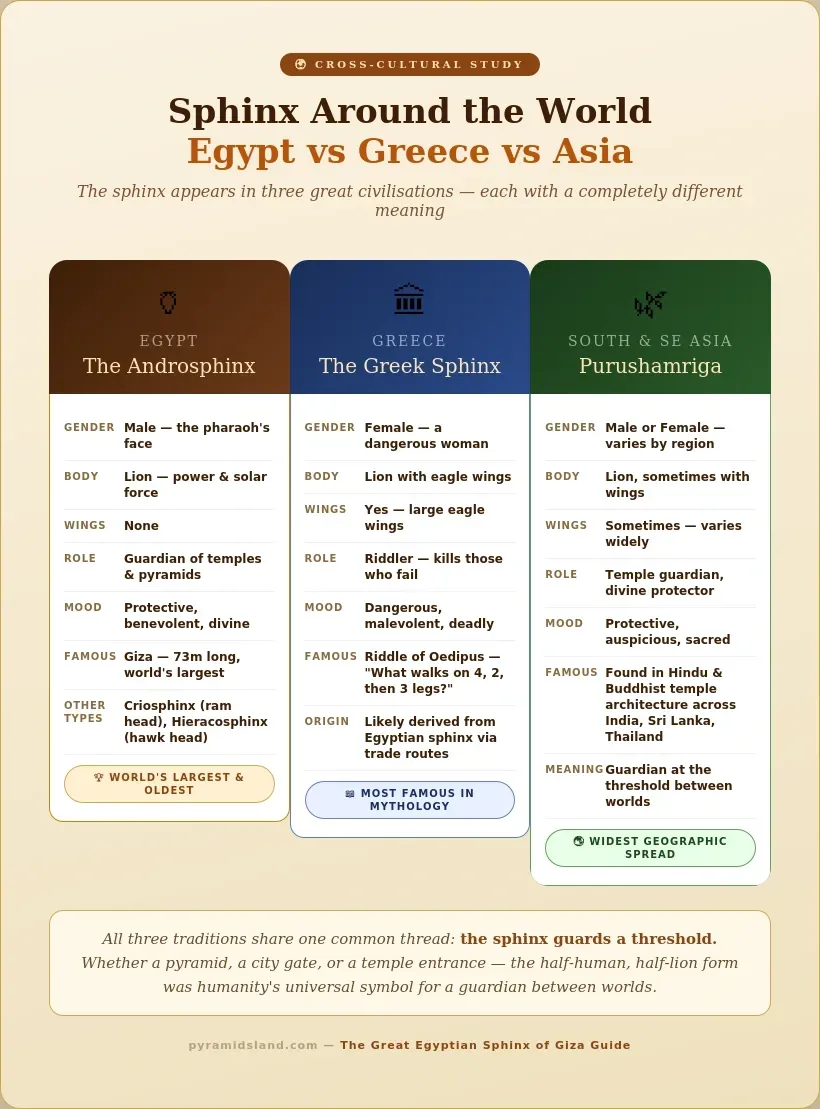
Egyptian Pyramids and civilizations always have a strong mystery side associated with them. Many unknown aspects make the study of culture more fascinating. One of the highlighting features of Egyptian society is its connection with Sphinx. What is the Egyptian Sphinx? How it is linked with Pyramids is a commonly asked question. Sphinx are structures that are built-in in human and animal forms. Moreover, the sphinx shapes -vary according to cultural variations connected with mythology. Also, various shapes of Sphinx are found in Egypt, Greece, Europe, and parts of southeast Asian countries. In Greece, the sphinx form is associated with women, but in Egypt, it is connected with men. However, the Egyptian Sphinx has more popularity globally; Egyptologists still study the giant massive structures. Let's dig more into the secrets and facts about the mysterious Egyptian Sphinx.
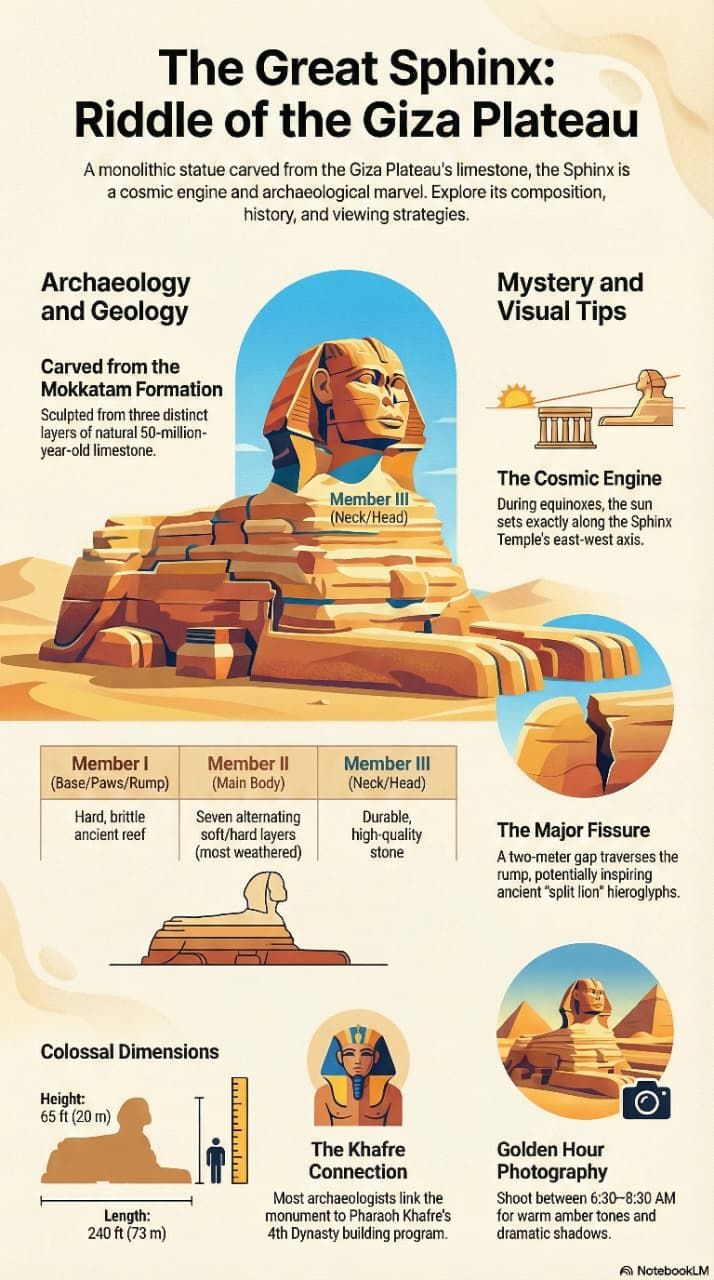
History of the Great Sphinx: When Was It Built?
The Great Sphinx of Giza dates to approximately 2558-2532 BC during the Old Kingdom period of ancient Egypt. Most Egyptologists agree that Pharaoh Khafre commissioned the statue as part of his pyramid complex, making it roughly 4,500 years old.
Mainstream Dating Evidence
Archaeological evidence supporting the Khafre construction theory includes:
- **Architectural alignment**: The Sphinx sits directly in line with Khafre's pyramid and valley temple
- **Facial resemblance**: The Sphinx's face closely matches surviving statues of Khafre
- **Construction style**: The limestone blocks and carving techniques match other Old Kingdom monuments
- **Historical context**: The Dream Stela between the paws references the statue during the New Kingdom (1400 BC), confirming its ancient origins
The Sphinx was carved from a single massive limestone outcrop. Researchers estimate that approximately 100 workers laboring for three years would have been required to complete the monumental sculpture.
Understanding the Sphinx requires knowledge of ancient Egyptian religion and pharaonic beliefs about the afterlife.
Alternative Theories
Some researchers have proposed much earlier construction dates, with claims ranging from 5000 BC to 10,000 BC. These theories primarily cite:
- Weathering patterns suggesting water erosion
- Astronomical alignments with star constellations
- Geological analysis of the limestone
However, these alternative dating theories are not accepted by mainstream Egyptology and remain highly controversial within the academic community. The consensus among credentialed Egyptologists continues to place construction during Khafre's reign around 2500 BC.
What We Know for Certain
Despite ongoing debates, certain facts about the Sphinx remain undisputed:
- It is carved from natural limestone bedrock at the Giza site
- It predates all written records specifically describing it
- It has undergone multiple restoration efforts throughout history
- It represents one of humanity's oldest large-scale sculptures
**According to the Egyptian Ministry of Antiquities, the Sphinx dates to approximately 2558-2532 BC during Khafre's reign.
History & Construction
The Great Sphinx of Giza
The second-largest pyramid in the world is also associated with the world's largest Sphinx. That makes the Giza structures more interesting. The Sphinx of Giza was supposed to have been built during the Old Kingdom, during the reign of Pharaoh Khafre (2558-2532 BC), who also built the Second Pyramid on the Giza Plateau. At 73 meters long and 20 meters high, this is the world's largest sphinx structure.
Sources
Unlike the Egyptian pyramids, the Sphinx lacks proper archaeological evidence. For instance, the Papyrus literary evidence from Wadi Al Jark helped reconstruct Egyptian pyramid history. Many questions were answered from the literary evidence found.
But here, in this context of Sphinx, all we get is the sphinx structure itself. The researchers study the structure and interpret it. However, there is no direct evidence or sources available in the context of Sphinx. It is only possible to make good interpretations based on other associated facts.
How was the Sphinx built?
The Sphinx, a massive and ancient statue, was made from a single piece of limestone. It's believed that building a large team of workers took about three years. The way the Sphinx was built shows incredible skill and workmanship, making it the oldest known monumental sculpture on Earth. Its construction remains a testament to the remarkable capabilities of ancient builders and sculpture.
The Sphinx was carved directly from the limestone bedrock of the Giza plateau using copper chisels, wooden wedges, and stone hammers. The construction process involved: **1. Site Selection**: Workers identified a large limestone outcrop suitable for carving **2. Rough Shaping**: Teams removed surrounding rock to expose the massive form **3. Detailed Carving**: Skilled artisans carved the facial features, body details, and paws **4. Surface Finishing**: The entire surface was likely smoothed and painted.
Construction Mysteries:
Archaeological evidence suggests construction may have been abandoned before completion: - Partially quarried bedrock remains near the site - Tool marks show inconsistent finishing on different areas - A workman's lunch and tools were found abandoned in place. The limestone blocks removed during excavation were repurposed for the adjacent Sphinx Temple and Valley Temple, demonstrating the ancient Egyptians' efficient use of materials.
This is paragraph text. Click it or hit the Manage Text button to change the font, color, size, format, and more. To set up site-wide paragraph and title styles, go to Site Theme.
**Research by Dr. Mark Lehner, one of the world's leading Sphinx experts, suggests the monument required approximately 100 workers over three years.
Physical Characteristics & Original Appearance
Dimensions of the Great Sphinx
-**Length**: 73 meters (240 feet)
-**Height**: 20 meters (66 feet) from base to top of head
-**Width**: 19 meters (62 feet) at the haunches
-**Face**: 4 meters (13 feet) wide
-**Material**: Single mass of nummulitic limestone
How the Sphinx Originally Looked
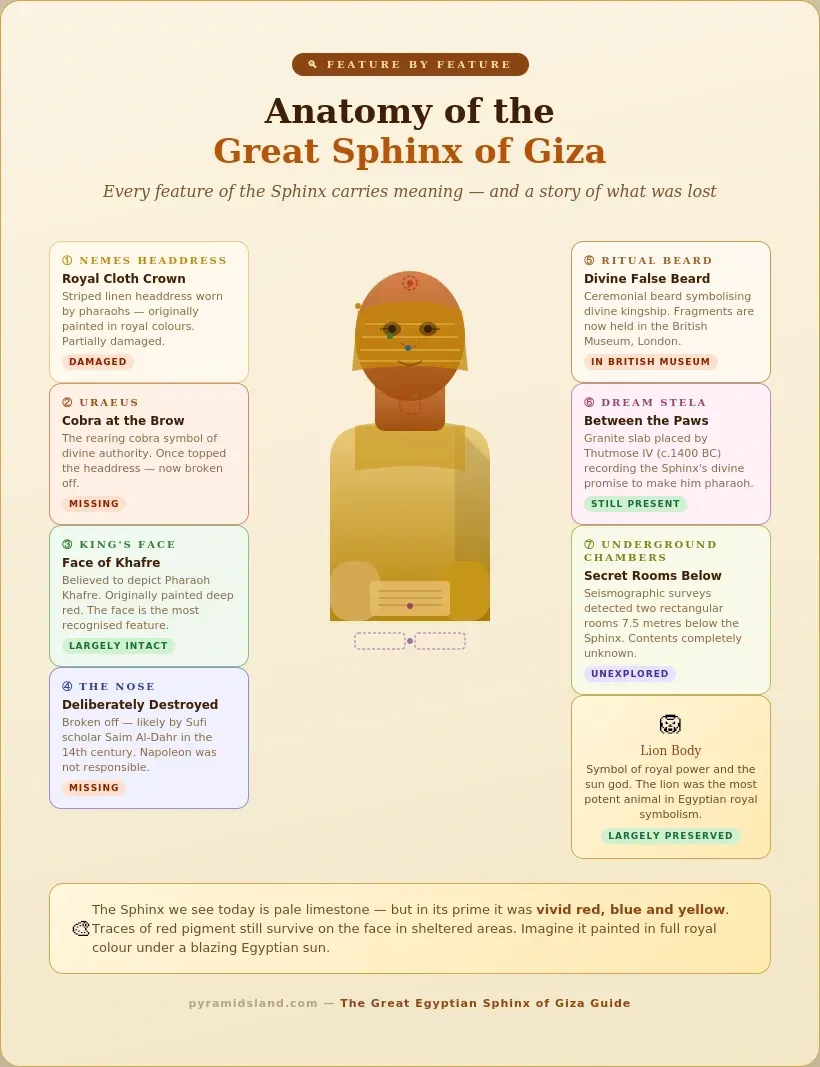
The Great Sphinx you see today is a pale shadow of its original glory. Scientific analysis and trace pigments reveal the statue was once vibrantly colored:
**Original Color Scheme** (based on pigment analysis):
-**Face**: Dark red ochre -
**Body**: Yellow and possibly blue/red stripes
-**Headdress**: Blue and yellow striations (nemes headcloth)
-**Beard**: Long ceremonial braided beard (now in British Museum)
-**Cobra emblem**: Royal uraeus on forehead (now missing)
The painted surface would have protected the limestone from erosion while presenting a majestic, imposing figure visible from great distances across the plateau.
Why Is the Sphinx's Nose Missing?
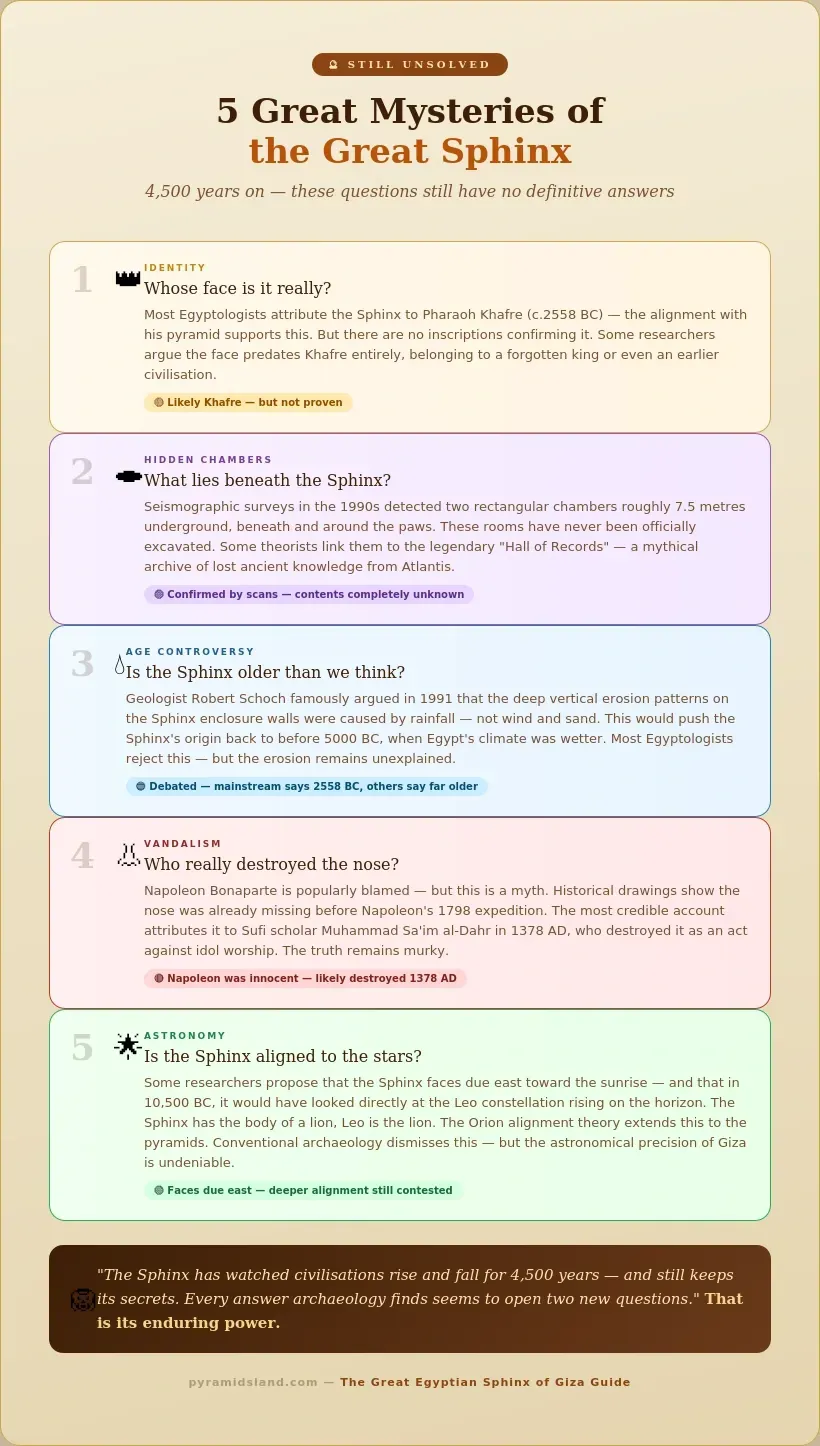
The missing nose is one of the Great Sphinx's most famous mysteries. Contrary to popular legend, **Napoleon's army did NOT shoot off the nose in 1798**. Historical drawings from the 1400s and 1700s show the nose was already missing centuries before Napoleon arrived in Egypt.
What Really Happened to the Nose
The most credible historical account attributes the damage to **Sa'im al-Dahr**, a 14th-century Sufi Muslim iconoclast. According to medieval Arab historian al-Maqrizi:
- In 1378 AD, Sa'im al-Dahr was disturbed by local farmers making offerings to the Sphinx
- Viewing this as idolatry forbidden in Islam, he vandalized the statue's face
- He was subsequently executed for his actions
- The nose and beard were already damaged by this time
-Medieval historian al-Maqrizi documented that Sa'im al-Dahr destroyed the nose in 1378 AD, as confirmed by 18th-century sketches predating Napoleon's arrival.
Other Missing Elements
Beyond the nose, the Great Sphinx has lost several original features:
-**Ceremonial beard**: Fragments now housed in the British Museum and Cairo Museum
-**Royal cobra (uraeus)**: The forehead emblem has completely disappeared
-**Paint and surface details**: Weathering has removed most colored pigments
-**Paws and body details**: Erosion has softened the carved musculature
The 1-meter-wide nose likely fell victim to deliberate iconoclasm rather than natural erosion, as the breakage pattern shows clean edges rather than gradual weathering.
Sphinx Mythology & Cultural Significance
The Great Sphinx occupied a complex role in ancient Egyptian religion, serving as a guardian, solar symbol, and divine representation across different periods.
Solar Deity Connection
During the New Kingdom (1570-1069 BC), the Sphinx became associated with **Harmakhet** ("Horus of the Horizon"), a form of the sun god Ra. Ancient Egyptians believed:
- The Sphinx channeled the power of the rising sun
- It protected the Giza necropolis from evil forces
- It represented the pharaoh's divine nature and power
- The eastward-facing orientation captured the first rays of dawn
There are many mythologies associated with the Sphinx. The superficial fancy structure strongly connects with people's beliefs and customs. The Egyptian Sphinx is often associated with gods and was considered a temple. Especially the sun god Horus has been linked with the giant structure. Moreover, in the earliest context of civilization, the lion symbolizes the sun.
In the medieval period, sphinxes were associated with various cults. Furthermore, Arabs considered the sphinx a powerful guardian of the desert region. On the other hand, Sphinx is linked as the gatekeeper or guardian of the pyramids.
The other mythology connected is the creature depicted in the sphinx structure. The animal has the body of a lion and the head of a man/woman. It asks riddles to travelers or to people who pass the pyramid or the desert; this was later mentioned in Greek Mythology in the story of Oedipus. Moreover, if the people failed to answer the riddle, the creature ate them; if they responded, they were allowed to travel. However, this is one of the most famous mythological stories associated with the Egyptian Sphinx. The sun god Ra played a central role in ancient Egyptian history.
The Riddle of the Sphinx
**Important distinction**: The famous riddle is from **Greek mythology**, not Egyptian tradition. The Great Sphinx of Giza never asked riddles.
Greek Mythology Confusion
In Greek legend (particularly the story of Oedipus), a different sphinx terrorized the city of Thebes by asking travelers: *"What walks on four legs in the morning, two legs at noon, and three legs in the evening?"*The answer: A human (crawling as a baby, walking as an adult, using a cane in old age). This Greek sphinx was female, with wings, unlike the male guardian sphinxes of Egypt.
What Egyptians Called the Sphinx
The ancient Egyptian name remains uncertain because:
- No Old Kingdom texts specifically name the Sphinx
- The word "sphinx" comes from Greek, applied 2,000 years after its construction
- New Kingdom texts refer to it as "Hor-em-akhet" (Horus of the Horizon)
- Medieval Arabs called it "Abu al-Hol" ("Father of Terror")
The riddle association stems from European scholars conflating Egyptian and Greek mythology during the Renaissance.
How many Sphinx are there?
In ancient Egypt, the Androsphinx, with a lion's body and a human head, was one of three types of sphinx. A Criosphinx, which had the form of a lion but the head of a ram instead of that of an eagle or hawk, was also among them.
Restoration & Conservation History
The Great Sphinx has undergone numerous restoration attempts over its 4,500-year history, some successful and others causing further damage.
Ancient Restorations
**Thutmose IV (1400 BC)**:
The first recorded restoration occurred when Prince Thutmose cleared the sand that engulfed the Sphinx. According to the Dream Stela between its paws, the Sphinx appeared to him in a dream, promising him kingship if he freed it from the sand.
**Ramesses II era (1279-1213 BC)**:
Additional clearing and minor repairs during the New Kingdom.
Modern Conservation Timeline
**1817**: Captain Giovanni Battista Caviglia made the first modern attempt to excavate the Sphinx, clearing the chest area but unable to complete the work.
**1858**: Auguste Mariette continued excavation, clearing more sand from the body.
**1925**: French engineer Émile Baraize conducted a major excavation, finally clearing the Sphinx entirely down to bedrock.
**1931**: Cement repair work began, but it used improper materials that actually accelerated erosion.
**1980s-1990s**: Large-scale restoration replaced failing cement with limestone blocks that matched the original material.
**1988**: A large piece of the right shoulder fell off, prompting emergency stabilization.
**2007**: Crisis point reached when rising groundwater threatened structural integrity. Pumping systems were installed to lower the water table.
**2014-Present**: Ongoing monitoring and conservation using modern materials and techniques.
The Getty Conservation Institute partnered with Egypt's Supreme Council of Antiquities in 2007 to address groundwater threats to the monument's structural integrity.
Current Threats
The Great Sphinx faces multiple deterioration factors:
-**Wind erosion**: Constant desert winds wear away soft limestone
-**Humidity**: Moisture from the underground water table damages stone
-**Pollution**: Cairo's air pollution accelerates chemical weathering
-**Salt crystallization**: Groundwater salts expand within the stone, causing cracking
-**Tourism pressure**: Though tourists cannot touch the Sphinx, vibrations and foot traffic affect the site
Despite these challenges, modern conservation efforts have stabilized the structure, ensuring the Great Sphinx will endure for future generations.
What Lies Beneath the Sphinx?
One of the most intriguing mysteries surrounding the Great Sphinx involves what may be hidden below and within the structure itself.
Scientific Investigations
**Seismographic Studies (1990s)**:
Seismic surveys conducted by geologists detected several anomalies:
- Rectangular chambers approximately 25 feet (7.6 meters) beneath the front paws
- Two distinct cavity zones beneath the body
- Tunnel-like features extending north of the Sphinx
**Known Chambers**:
-**Shaft in the back**: A documented hole in the Sphinx's rump, purpose unknown
-**Tunnel near tail**: A small passage of uncertain origin
-**Dream Stela chamber**: The space between the front paws containing Thutmose IV's stela
The "Hall of Records" Theory
Some researchers speculate these underground chambers may contain:
- Ancient Egyptian records or archives
- Artifacts from predynastic periods
- The mythical "Atlantis records" (completely unproven)
**Important Note**: Egyptian authorities have not excavated these suspected chambers. The reasons include:
- Structural concerns about damaging the Sphinx
- Lack of compelling evidence justifying invasive exploration
- Political and archaeological protocol issues
Until proper archaeological excavation occurs, what lies beneath the Great Sphinx remains one of ancient Egypt's enduring enigmas.
Sphinx and Astronomy
Astronomy is a field with strong connections to humankind's earliest civilizations. A few scholars interpreted the Sphinx as a powerhouse that extracts energy from the sun. Also, some believed that the Sphinx is connected to star constellations. Especially stars like Leo, the Milky Way, and Orion. Few interpret that the alignment of the sphinx is precise to the star constellations.
What are 5 facts about the Great Sphinx?
- The ideal concept of the sphinx found in Greece is different from the sphinx found in Egypt.
- The construction of the Great Sphinx of Giza seems unfinished. The archaeological evidence suggests that the tools and raw materials used for the sphinx's construction were abandoned in between. However, the present Sphinx structure is also incomplete.
- Unlike today's sphinxes, ancient sphinxes were colorful. The studies show that the system's body might have been colored blue and yellow. Whereas the face must have been red.
- In the present Sphinx structure at Giza, the central head parts, such as the nose, beard, and headdress, are missing. Many restoration works have been carried out on the structure.
- Between the frontal paws of the Sphinx is a huge palette called the Dream Stela, and it is attributed to Pharaoh Thutmose iv
- There is no evidence that Napoleon Bonaparte was responsible for destroying the Sphinx's nose. Although this concept is quite popular, there is no proper, valid evidence to prove it. It was probably done by a guy named Saim Al-Dahr in the 14th Century; he was a Sufi Muslim and feared that people would worship the Sphinx statue.
- The Great Sphinx of Giza is considered the oldest monument in the world.
In the Modern Context
The Sphinx of ancient Egypt has undergone various phases of history. The Egyptian government has undertaken many measures to preserve the historic structure in today's context. Large-scale investment in the conservation and preservation of the Egyptian Sphinx and pyramids has been undertaken.
Visiting the Sphinx Today
Essential Visitor Information
**Location**: Giza Plateau, approximately 13 km (8 miles) southwest of downtown Cairo
**Opening Hours**:
- Daily: 8:00 AM - 5:00 PM (April-September)
- Daily: 8:00 AM - 4:00 PM (October-March)
**Ticket Information**:
- The Sphinx is included in the general Giza Plateau ticket
- Adult ticket: Prices vary (check current rates)
- Photography allowed (no tripods inside)
- No separate Sphinx ticket required, but to be in the precinct of the Sphinx, this requires special access
**Access**:
Visitors view the Sphinx from designated viewing platforms. You cannot walk up to or touch the monument. The closest viewing point is approximately 10 meters from the statue.
Plan your trip with our comprehensive Cairo travel guide for transportation and accommodation advice.
Best Time to Visit
**Optimal Visiting Times**:
-**Early morning (8:00-9:30 AM)**: Fewer crowds, cooler temperatures, soft morning light
-**Late afternoon (3:30-5:00 PM)**: Golden hour lighting perfect for photography
-**Avoid midday**: Extreme heat, harsh shadows, maximum crowds
**Seasonal Considerations**:
-**Winter (November-February)**: Most comfortable weather, peak tourist season
-**Spring/Fall (March-April, September-October)**: Moderate temperatures, good compromise
-**Summer (May-August)**: Extremely hot but fewer tourists
Photography Tips
1.**Best angles**: Northeast side captures Sphinx with Khafre pyramid in background
2.**Morning light**: Illuminates the face beautifully from the east
3.**Sunset shots**: Dramatic backlighting and golden colors
4.**Wide-angle lens**: Essential for capturing the full scale
5.**Viewpoint platforms**: Use upper levels for elevated perspectives
What to Bring
-**Water**: Essential in a hot climate (1-2 liters per person)
-**Sun protection**: Hat, sunglasses, high-SPF sunscreen
-**Comfortable shoes**: You'll walk on uneven ancient stones
-**Light clothing**: Modest but cool; respect local customs
-**Camera**: No professional equipment restrictions for personal use
Guided Tours vs Independent Visit
**Independent Visit**:
- Freedom to spend as much time as desired
- Lower cost
- Requires research and navigation skills
- May miss historical context
**Guided Tour** (Recommended):
- Expert Egyptological explanations
- Skip lines and optimized routing
- Transportation included
- Access to restricted areas is sometimes possible
- Book our Sphinx and Pyramids tour here
💡 Insider Tips from Our Guides
- Best photo spot: Northeast viewing platform at sunrise captures the Sphinx with Khafre's pyramid perfectly aligned
- Avoid crowds: Visit within the first hour of opening (8:00-9:00 AM) or last hour before closing
- Optimal season: November through February offers comfortable temperatures and clear skies
- Hidden view: The upper platform offers rarely photographed angles from above
- Skip the scams: Ignore anyone offering "special access" or "best photography spots" for extra fees
Want expert guidance? Book a private Egyptologist-led tour →
Sources & Further Reading
This article draws on archaeological research, Egyptological studies, and firsthand expertise from licensed guides. Key sources include:
**Academic & Archaeological Sources:**
- Lehner, Mark. *The Complete Pyramids*. Thames & Hudson, 2008.
- Hawass, Zahi. *The Secrets of the Sphinx: Restoration Past and Present*. American University in Cairo Press, 1998.
- Egyptian Ministry of Tourism and Antiquities official documentation
**Conservation Studies:**
- Getty Conservation Institute. "Sphinx Conservation Project" (2007-2010)
- Supreme Council of Antiquities restoration reports
**Historical References:**
- Al-Maqrizi, medieval Arab historian (14th-15th century writings on the Sphinx)
- Napoleon's expedition scholarly documentation (*Description de l'Égypte*, 1809-1829)
**Modern Research:**
- Seismic survey data from geological studies (1990s)
- Current conservation monitoring by Egyptian authorities
For the most current visiting information, always check the [official Egyptian Ministry of Tourism website](https://www.egypt.travel/) before your trip.
Conclusion
The Egyptian Sphinx is known for its giant structure and mysterious associations. It is one of the world's oldest monuments and plays a crucial role in the history of Egypt. Furthermore, the connection of the Egyptian Sphinx from the pre-Old Kingdom to the later period underscores its importance. Since its discovery, many incidents involving Sphinx have occurred.
Egyptologists and researchers worldwide have conducted numerous studies on the Egyptian Sphinx. Still, many aspects of the sphinx remain unanswered, making it even more mysterious. As a witness to the Egyptian past, the massive structure had taken root in the soil of Egypt.
Ready to explore? Check out Planning a trip to Egypt

Can you go inside the Great Sphinx?
No. The Sphinx is solid limestone with no interior chambers accessible to tourists. Any cavities that may exist remain unexplored and sealed.
How long did it take to build the Sphinx?
Estimates suggest approximately 3 years with a workforce of 100 skilled laborers working continuously.
Is the Sphinx mentioned in the Bible?
No. The Sphinx is not mentioned in biblical texts. It predates most biblical events by centuries.
What color was the Sphinx originally
Pigment analysis reveals the face was dark red, with the body featuring yellow, blue, and red coloration.
Why don't they restore the Sphinx's nose?
Modern conservation philosophy avoids reconstructing missing elements. Restoration focuses on stabilizing existing material rather than creating new historical features.
Frequently Asked Questions About the Sphinx

Ashraf Fares