
Gold Tongues and Hundreds of Coffins: What Egypt's Newest Cemetery Find Tells Us About Mummification
The short answer
On November 18, 2026, Egypt's Ministry of Tourism and Antiquities announced a large cemetery at Tell Kom Abu Billo, the ancient town of Terenouthis, in Menoufia Governorate about 70 km northwest of Cairo. An Egyptian mission found hundreds of stone and pottery coffins in one open courtyard, several tongue-shaped gold amulets, scarabs, faience ushabti figures and two falcon burials. Most burials date to the 3rd and 2nd centuries BC. Gold tongues were placed in the mouth so the dead could speak in the afterlife. The site is an active excavation and is not a visitor site. The same period and the same burial customs can be seen at Saqqara and in Cairo's museums.
On November 18, 2026, a team from Egypt's Supreme Council of Antiquities showed the world a courtyard full of coffins. Hundreds of them, stone and pottery, packed side by side under the sand at the western edge of the Nile Delta. Between the coffins lay two buried falcons. In the mouths of some of the dead, thin tongues cut from gold.
Here is what was found, what it means, and where you can stand in front of the same things without leaving Cairo.
What was found at Kom Abu Billo?
The site is Tell Kom Abu Billo, in Menoufia Governorate, roughly 70 km northwest of Cairo. In antiquity this was Terenouthis, a market town on the Rosetta branch of the Nile.
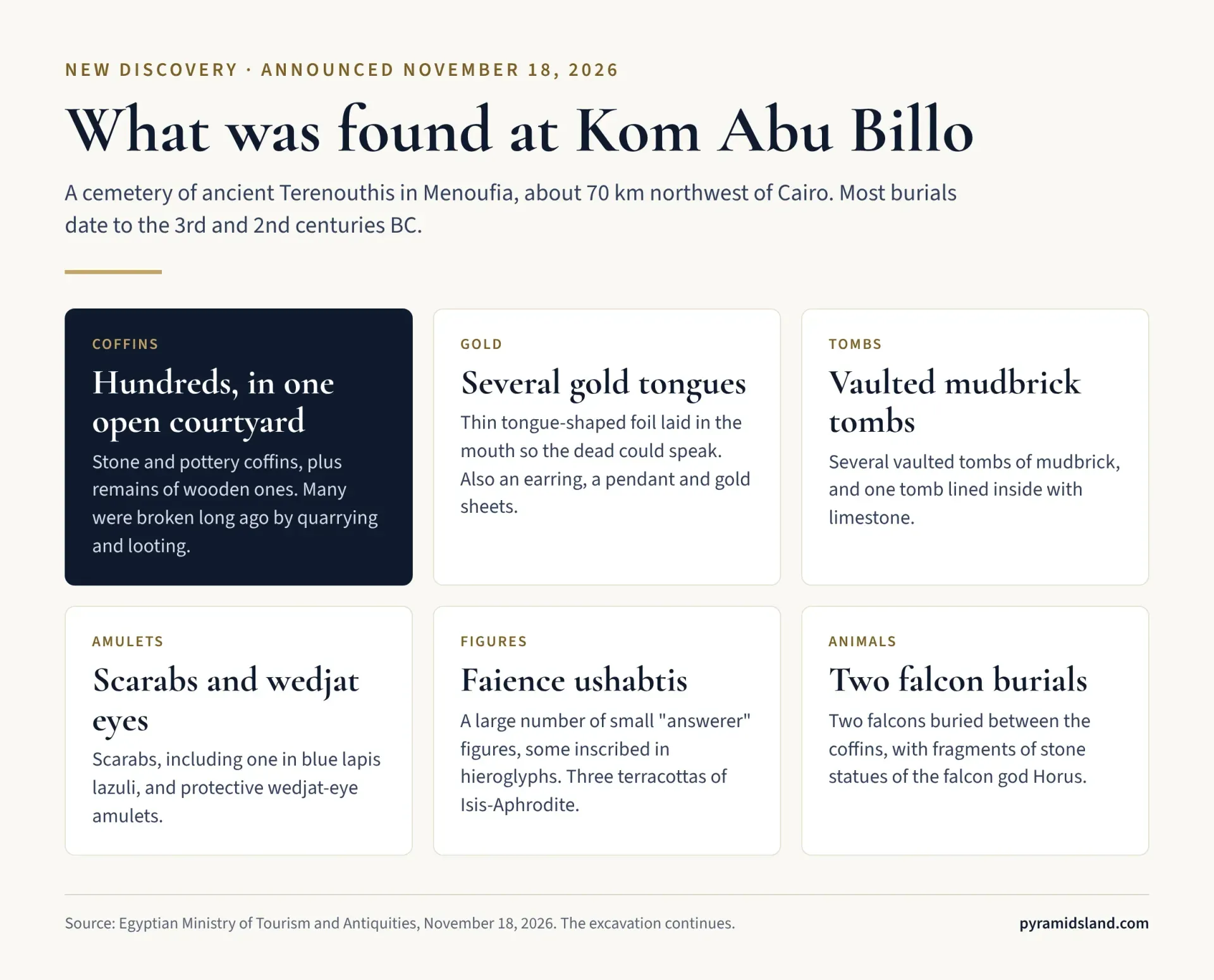
The mission uncovered a large cemetery with stone and pottery coffins, the remains of wooden ones, vaulted mudbrick tombs, and one tomb lined inside with limestone. Mostafa Rizk, who heads antiquities in Menoufia, described a surface layer holding hundreds of stone coffins. Some had no lids. Many had been smashed long ago by quarrying and looting. Some of the pottery coffins carry rough, almost cartoon-like human faces. Others are shaped like a wrapped body.
With the dead were several gold tongues, a gold earring, a pendant and sheets of gold foil. There were scarabs, including one in blue lapis lazuli, wedjat-eye amulets, and a large number of faience ushabti figures, some inscribed in hieroglyphs. The team also found three terracotta figures of Isis-Aphrodite and a vessel lid showing her seated on a lotus, nursing the child Harpocrates.
Mohamed Abdel-Badie, head of the Egyptian Antiquities Sector, dated most of the cemetery to the early Ptolemaic period, the 3rd and 2nd centuries BC, with some burials from the end of the Late Period. Dr. Hisham El-Leithy, Secretary-General of the Supreme Council of Antiquities, said the site has never before produced this many burials and coffins in one open courtyard. He added that the grave goods point to middle-class owners. More structures run on under the sand, and the dig continues.
That detail matters. These were not kings. They were traders, scribes and their families, and they still wanted gold in their mouths.
Why did Egyptian mummies have gold tongues?
A gold tongue is a small piece of gold foil, cut in the shape of a tongue and laid in the mouth of the dead so that the person could speak in the afterlife.
Speech mattered because the Egyptian afterlife began with a hearing. In the Book of the Dead, the dead stand before Osiris and a panel of judges and declare, one statement at a time, what they did not do in life. A person who cannot speak cannot make that declaration. The ministry gave the same explanation for this find: the tongues were meant to let the dead speak in the next world.
Why gold? It does not tarnish or decay, and Egyptians called it the flesh of the gods. A tongue of flesh rots. A tongue of gold is still there two thousand years later, as this courtyard shows.
The custom belongs mostly to the Greek and Roman centuries of Egyptian history. Gold tongues turned up at Taposiris Magna near Alexandria in 2021, at Quesna in the central Delta in 2022, and repeatedly at Oxyrhynchus in Middle Egypt. The Egyptologist Salima Ikram has suggested that some of these clusters may reflect the house style of a local embalming workshop. That fits Kom Abu Billo, where one town buried its dead in one place over several generations.
Notice what else lay in those coffins. The ushabti is usually translated as "answerer": a figure that answers on your behalf when you are called to work in the next world. The gold tongue lets you speak. The ushabti answers for you. An ordinary family in a Delta market town paid for both.
What is natron, and what does Wadi El Natrun have to do with it?
Natron is a natural salt, mostly sodium carbonate and sodium bicarbonate, that pulls water and fat out of a body. It is what made Egyptian mummification work.
Terenouthis stood at the eastern entrance to Wadi El Natrun, a desert depression of salt lakes about 100 km northwest of Cairo. The valley takes its name from the natron that forms along those lakes. The ministry's own statement makes the connection: the town sat on the road to the place Egypt's embalmers depended on.
One caution. The team reported traces of embalming resins on the remains at Kom Abu Billo. It did not report finding natron in these burials. The link is the town's location, not a laboratory result.
How were mummies actually made?
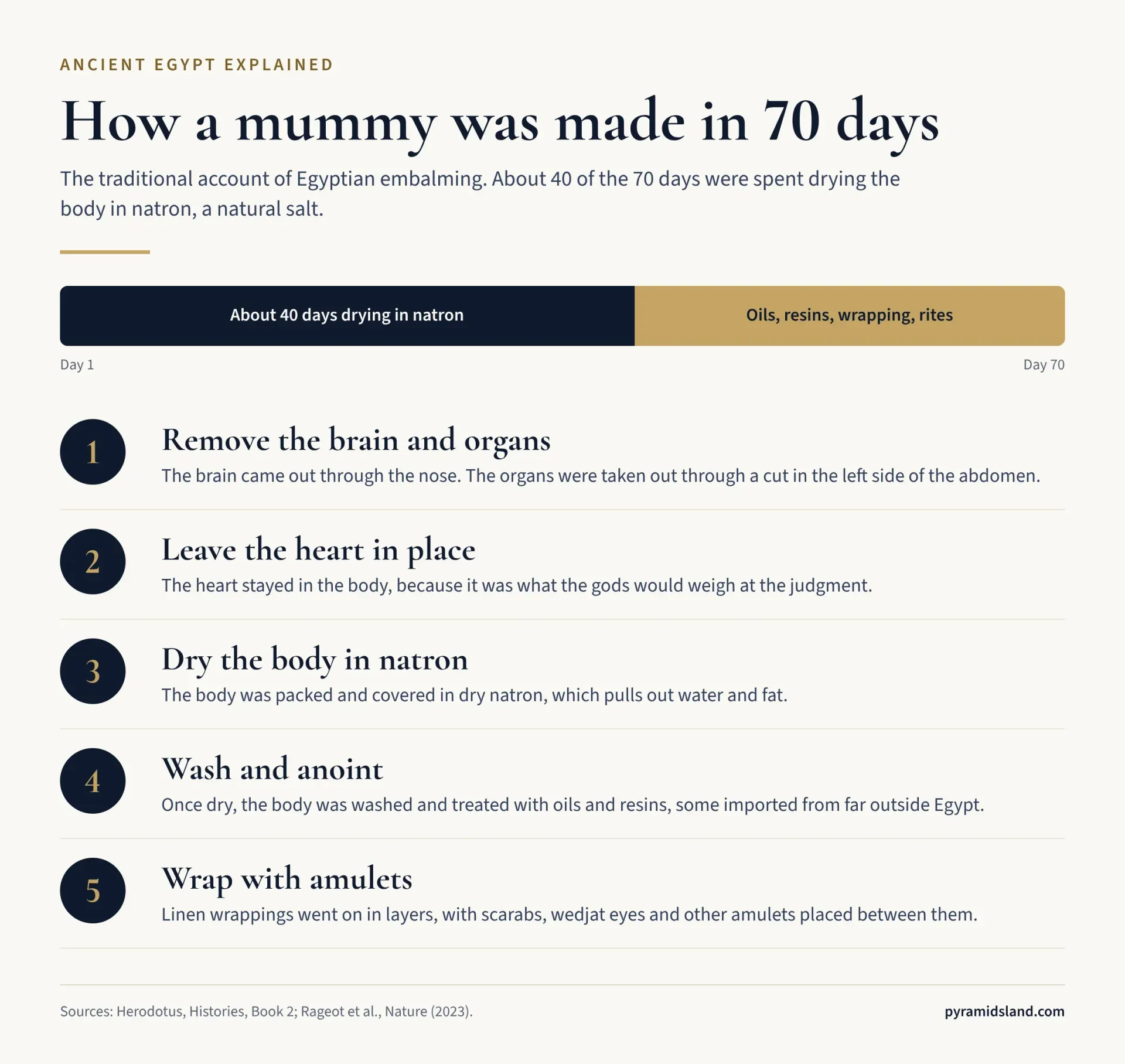
By the traditional account the whole process took 70 days, and about 40 of those were spent drying the body in natron.
The embalmers removed the brain through the nose, opened the left side of the abdomen and took out the internal organs. The heart stayed in place, because the heart was what the gods would weigh. The body was packed and covered in dry natron. Once it was dry it was washed, anointed with oils and resins, and wrapped in linen with amulets placed between the layers. Scarabs and wedjat eyes like the ones from Kom Abu Billo went in at this stage.
The Greek historian Herodotus, who visited Egypt about two centuries before these burials, wrote that embalmers offered three grades of service at three prices. A middle-class cemetery is where you see that price list in practice: pottery coffins beside stone ones, plaster and cartonnage painted yellow, red, blue and gold, a little real gold for those who could afford it.
We also know what was in the embalmers' jars. In 2016 an embalming workshop was found at Saqqara, close to the Pyramid of Unas, dating to 664–525 BC. Its pots were still labeled. One read, in effect, "to be put on his head." A study published in Nature in 2023 analyzed 31 of them and identified cedar and juniper oils, pistachio resin, beeswax, animal fat and bitumen from the Dead Sea. It also found two resins, elemi and dammar, that probably came from tropical forests in Asia. Embalming was an international supply chain six centuries before Christ.
Can you visit Kom Abu Billo?
No. Tell Kom Abu Billo is a working excavation, not a ticketed site, and we do not offer it. Nothing in the announcement mentions opening it to visitors, and the objects will go to study and conservation first.
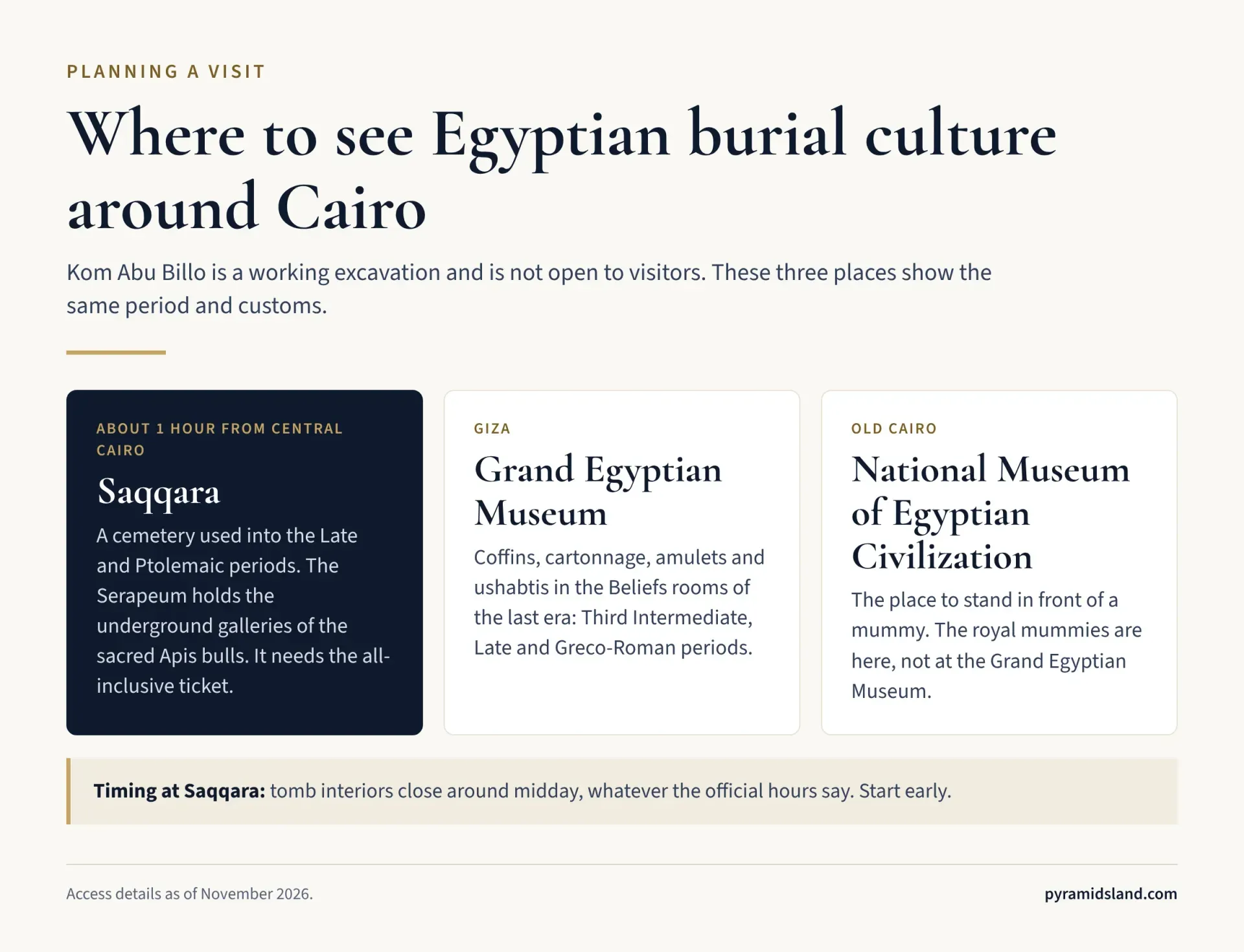
You do not need to go there. The same centuries, the same customs and far better-preserved examples are within an hour of a Cairo hotel.
Where can you see this period around Cairo?
Saqqara. Most visitors know Saqqara for the Step Pyramid, 2,400 years older than this find. But Saqqara stayed in use as a cemetery into the Late and Ptolemaic periods, and it is where the two falcons from Kom Abu Billo make sense. In those centuries Egyptians mummified sacred animals in enormous numbers. At the Serapeum you walk underground galleries cut for the Apis bulls, each buried in a granite sarcophagus weighing tens of tons. The Serapeum is open. It is covered by the Saqqara all-inclusive ticket and not by the standard entrance ticket, so tell us before your tour if you want it. The embalming workshop described above lies near the Pyramid of Unas. The workshop itself is closed to visitors, but your guide can show you where it was found.
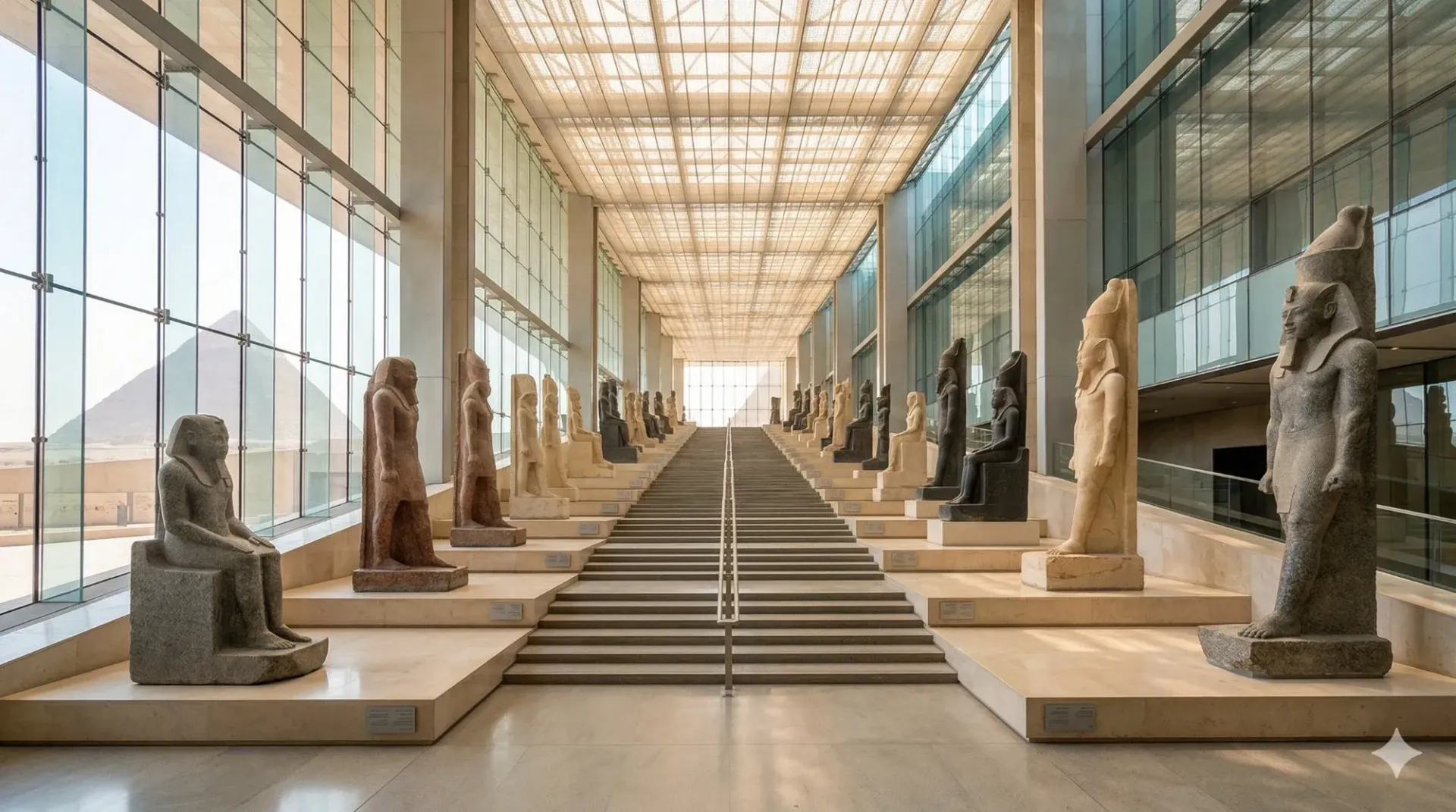
The Grand Egyptian Museum. The main galleries are arranged by era, and each era is divided into Society, Kingship and Beliefs. For this subject, go to the Beliefs rooms of the last era, which covers the Third Intermediate, Late and Greco-Roman periods. This is where coffins, cartonnage, amulets and ushabtis of the Kom Abu Billo type are displayed, along with a full-size mummified crocodile. These rooms are not part of our standard GEM route, which concentrates on the highlights and Tutankhamun. On a private tour you can ask your guide at the start to include them.
The National Museum of Egyptian Civilization. If what you want is to stand in front of a mummy, this is the place, and not the GEM. The royal mummies are here, in Old Cairo. Our guide to Egypt's royal mummies explains who is in which case.
Travelers heading south should add the small Mummification Museum on the Luxor corniche, which displays the embalmers' tools.
Saqqara with an Egyptologist
A cemetery is hard to read alone. At Kom Abu Billo the story is in the details: a cheap pottery coffin beside a stone one, a falcon between two graves, a slip of gold foil. Saqqara is the same. Without someone to point, you see sand and doorways.
Our private Saqqara day tour gives you your own Egyptologist, your own car and driver. It is about an hour's drive from central Cairo. We start early, because the tomb interiors at Saqqara close around midday whatever the official hours say.
If this find has you thinking about seeing Egyptian burial culture properly, message us on WhatsApp with your dates and we will tell you what is open and how we would plan the day.
Sources: Egyptian Ministry of Tourism and Antiquities statement, November 18, 2026, as reported by Daily News Egypt, Arab News, The National and Anadolu Agency. Rageot et al., "Biomolecular analyses enable new insights into ancient Egyptian embalming," Nature 614 (2023). Herodotus, Histories, Book 2.
Ashraf Fares