Private Coptic Cairo & Coptic Museum Tour

A private experience shaped around your time and interests.


★ 4.9 · 2,678 reviews on TripAdvisor · Licensed since 2001 · Free Cancellation
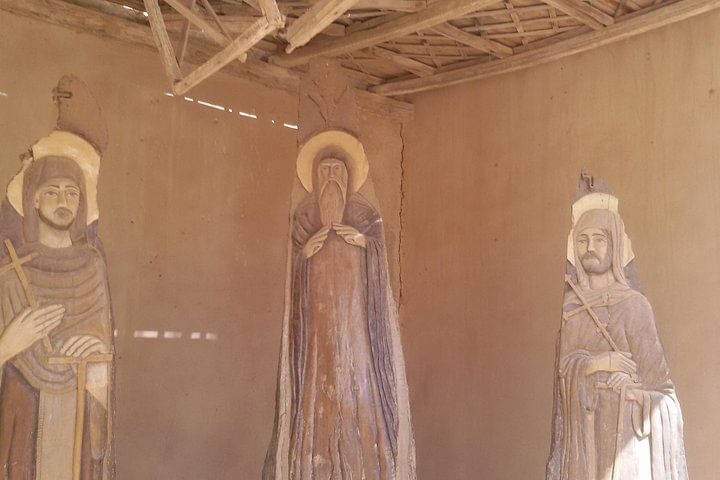
8-Hour Private Tour of the Pyramids, Sphinx, Grand Egyptian Museum

6 hours

Easy

Minimum age: 1


Most visitors to Egypt focus entirely on ancient and Islamic history. The third chapter — Coptic Cairo — is frequently overlooked, which means it is almost always quiet when you visit.

Old Cairo (Babylon) is the oldest continuously inhabited part of the city. It was the center of Roman-era Egypt, the refuge of the Holy Family according to Christian tradition, and the origin point of the Coptic Orthodox Church — one of the oldest Christian communities in the world.

This tour gives that history the guided attention it deserves.

Who This Tour Is For

  • Travelers with a specific interest in early Christianity and its Egyptian roots
  • Those who want to understand Egypt as a multi-faith civilization across 5,000 years
  • Visitors who find the quiet, uncrowded sites more compelling than the famous ones
  • Anyone on a Cairo trip who wants a meaningful half-day alternative to more Pyramids

What You Will See

The Hanging Church (Al-Muallaqah)

Built above the south gate of the Roman fortress of Babylon, this church has been in continuous use since the 3rd century. The nave appears to "hang" between two Roman towers — hence the name. Some of its original 4th-century architectural elements remain intact.

The Coptic Museum

The largest collection of Coptic art in the world — manuscripts, textiles, ivories, and metalwork from the 1st through 19th centuries. The museum traces the transformation from Pharaonic to Christian iconography in Egypt, a transition visible nowhere else so clearly.

The Ben Ezra Synagogue

One of the oldest synagogues in the world, and the site where the Cairo Geniza — a collection of 300,000 medieval Jewish documents — was discovered in 1896. The restored interior is quietly extraordinary.

The Church of St. Sergius and Bacchus

Built over the crypt where the Holy Family is believed to have sheltered during their flight to Egypt. One of the oldest churches in Cairo — the crypt itself dates to approximately the 4th century.

✦ The floor of the Coptic Museum contains a section of Roman mosaic that was part of the Babylon fortress. Modern visitors walk across it on glass panels. Your guide will stop here and show you the three layers of history visible from a single spot: Roman, Coptic, and Islamic Cairo — all within 100 meters of each other.

Our Guide Note

Coptic Cairo is the oldest continuously inhabited part of the city, and almost every visitor walks past its most important detail without noticing it. The Church of St Sergius and Bacchus is built over a crypt where, according to Coptic tradition, the Holy Family sheltered during their flight into Egypt. The crypt floods seasonally — it sits below the water table of the ancient Nile — and the smell of old water and incense in that small underground space is unlike anything else I know. The Hanging Church next door is suspended over the gatehouse of the old Roman fortress of Babylon, which is why it has no foundations in the conventional sense. The Moqqatam Cave Church is the final stop — carved directly into the cliff face of the Moqqatam mountain by a community of Coptic rubbish collectors who transformed a mountain into a cathedral. It holds 20,000 people. Most tourists never find it.

Common First-Time Questions

Is a dress code required?

 Yes — covered shoulders and knees for all sites, including the museum. This applies to all genders. Scarves or wraps are available at the entrance to each religious site if needed. 

Can this be combined with a visit to Islamic Cairo in one day? 

Yes — Coptic Cairo and Islamic Cairo are 20 minutes apart. A combined full day covering both is available. Ask us about the itinerary before booking — the sequence matters for pacing. 

Will I be pressured to buy anything? 

No. This is a private tour. We do not include commission-based stops and your guide will not redirect the itinerary for shopping. 

Can the pacing or order be adjusted? 

Yes. This is private — the schedule adapts to you. If you want to spend longer at one site or skip something, tell your guide. 

Is this suitable for travelers arriving from a long flight? 

We recommend scheduling your first full tour after at least one night of sleep in Egypt. If you are booking for arrival day, we can discuss a gentler start time.


What's included?
  • Food & drinks
  • Private hotel pickup and drop-off in Cairo or Giza
  • • Private, air-conditioned vehicle throughout
  • • Licensed Egyptologist guide, full tour
  • • Entrance fees to all listed sites
  • • Lunch at a local restaurant
  • Bottled water


Exclusions
  • Tip or gratuity
  • Tips
  • Personal expenses
Please note

    Pickup & Timing: Your guide contacts you the evening before your tour via WhatsApp to reconfirm the exact pickup time and your hotel details. Pickup is from the lobby of any hotel in Cairo or Giza (Luxor or Aswan for southern tours). If you're staying in an Airbnb or non-hotel accommodation, share your location pin when booking so your driver can find you easily.

    What You'll Pay On-Site: All entry fees listed in the itinerary are included. If you choose optional upgrades during the tour — such as entering the Tutankhamun tomb, the Seti I tomb, or the Great Pyramid interior — these are paid on-site by credit or debit card. Your guide will advise whether each upgrade is worthwhile before you decide. Cash is no longer accepted at most major archaeological sites in Egypt.

    Weather & Sun Egypt is hot and dry for most of the year. From October to March, daytime temperatures in Cairo are comfortable (18–25°C / 65–77°F), but mornings can be cool. From April to September, expect 35–45°C (95–113°F) at open-air sites. The Giza Plateau, Valley of the Kings, and Karnak have almost no shade. Your guide schedules site visits to avoid the worst midday heat, but sun protection is essential regardless of season.

    Dress Code: Dress comfortably and modestly. At mosques (Al-Hussein, Al-Azhar, Alabaster Mosque), shoulders and knees must be covered — this applies to all genders. At archaeological sites, there is no dress code, but lightweight long sleeves protect against the sun better than sunscreen alone. Comfortable closed-toe shoes with grip are essential — sites involve walking on sand, uneven stone, and rough terrain.

    Photography: Photography is permitted at most outdoor archaeological sites. Inside tombs (Valley of the Kings), photography is generally prohibited unless you purchase a separate photography ticket. Inside the Grand Egyptian Museum, photography rules vary by gallery — your guide advises on the day. Drone photography at all archaeological sites requires permits that are extremely difficult to obtain. Do not fly a drone without confirmed authorization.

    Payments & Currency Egypt's currency is the Egyptian Pound (EGP). Most tourist-facing businesses accept credit/debit cards and USD. Your guide and driver accept tips in EGP, USD, or EUR. ATMs are widely available in Cairo, Luxor, and Aswan. Recommended tipping: $5–10 per person for your guide on a half-day tour, $10–15 on a full day. $3–5 for your driver.

    Health & Safety: Drink only bottled water (provided on your tour). Tap water in Egypt is not safe for tourists. Carry any personal medications you need — pharmacies are available but may not stock specific brands. Apply sunscreen before departure, not on-site — you'll be in the sun within minutes of arriving at most sites. Travel insurance is required for all tours and is not provided by Pyramids Land.

    Cultural Notes: Egyptians are genuinely welcoming. "Shukran" (thank you) and "Salaam alaikum" (peace be upon you) go a long way. At tourist sites, you may be approached by local vendors or people offering unsolicited help (leading you to a viewpoint, taking your photo). A polite "la, shukran" (no, thank you) works. Your guide manages these interactions so you don't have to.

    What to bring
      • Comfortable closed-toe shoes with grip (sand, uneven stone, rough terrain at all sites)
      • Hat with a brim — essential at Giza, Saqqara, Valley of the Kings, Karnak, and all open-air sites
      • Sunscreen (apply before departure — you'll be in the sun immediately on arrival)
      • Sunglasses
      • Camera or smartphone (charged — there are no charging points at sites)
      • A light scarf or shawl for mosque visits (shoulders and knees covered)
      • Small daypack for water, camera, and sun protection
      • Any personal medications you need during the day

      We provide bottled water throughout the tour. You do not need to bring your own.

      Explore the tours above. Read the details. Ask questions if needed. Book only when it feels right.

      How pricing works

      Prices are based on:

      • Group size
      • Duration
      • Inclusions listed on the tour page

      You will always know what is included before booking. There are no surprise additions.
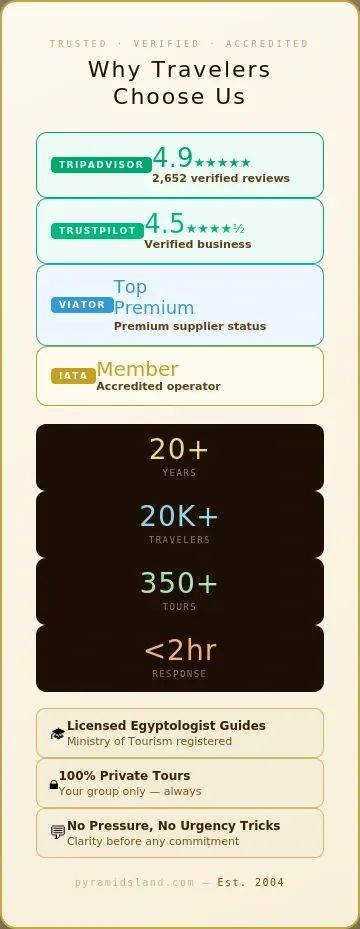
      What our clients say


      View of the Great Pyramid through a car windshield with a water bottle on the dashboard approaching
      By Ashraf Fares May 24, 2026
      Honest time budgets by layover duration — what's possible, what's not, and why we never take you to a souvenir shop. From the operator who runs these tours weekly.
      Traditional wooden dahabiya with white sails beside a large illuminated Nile cruise ship at dusk
      By Ashraf Fares May 21, 2026
      Side-by-side comparison from the operator who books both — passengers, sites, amenities, price, and which one matches how you actually travel.
      View from inside a hot air balloon basket at sunrise over the Nile with dozens of balloons in the sk
      By Ashraf Fares May 17, 2026
      Safety, scams, physical requirements, photography tips, and how the balloon fits into your Luxor day — from the operator who books this weekly.
      Senior traveler seated in an Egyptian temple while her guide points out hieroglyphs on a carved colu
      By Ashraf Fares May 14, 2026
      Can older travelers visit Egypt? Honest accessibility for the Pyramids, Karnak, Valley of the Kings, Abu Simbel, and Nile cruises — three mobility levels, from a Cairo operator.
      Discreet handshake with folded Egyptian pound notes inside an ancient temple doorway
      By Ashraf Fares May 11, 2026
      Specific 2026 tipping amounts for guides, drivers, hotels, cruises, restaurants, and tomb guards. From the Cairo operator who briefs every traveler before they land.
      Woman in loose linen clothing browsing ceramics at an Egyptian souk with a draped scarf over her sho
      By Ashraf Fares May 8, 2026
      Location-specific dress guidance for Cairo, Luxor, temples, mosques, and Nile cruises — plus the insider tips no travel blog covers. From a Cairo-based operator.
      Family spotting their guide holding a name sign at Cairo International Airport arrivals
      By Ashraf Fares May 5, 2026
      Step-by-step Cairo airport arrival — visa, passport control, baggage scams, the taxi gauntlet, and the drive to your hotel. Two versions: alone vs. with a guide.
      Solo traveler standing among ancient Egyptian temple columns at golden hour
      By Ashraf Fares May 2, 2026
      7 things that overwhelm visitors in Egypt — named honestly, then handled specifically. From the operator with 2,652 five-star reviews and 20 years on the ground.
      The four colossal statues of Ramesses II at Abu Simbel at dawn, dwarfing a single visitor standing a
      By Ashraf Fares April 27, 2026
      The definitive guide to Ramesses II — Battle of Kadesh, Abu Simbel's solar alignment, the world's first peace treaty, and where to see his monuments in 2026.
      Scuba diver beside a vibrant coral wall with barracuda schooling in the deep blue Red Sea
      By Ashraf Fares April 6, 2026
      The complete guide to diving Egypt's Red Sea. Ras Mohammed, Thistlegorm, Elphinstone, Blue Hole — where to go, what level you need, and what to budget.
      Show More