

★ 4.9 · 2,678 reviews on TripAdvisor · Licensed since 2001 · Free Cancellation
Classic Egypt Tours
Private. Egyptologist-led. Built for first-time visitors who want Egypt done properly.
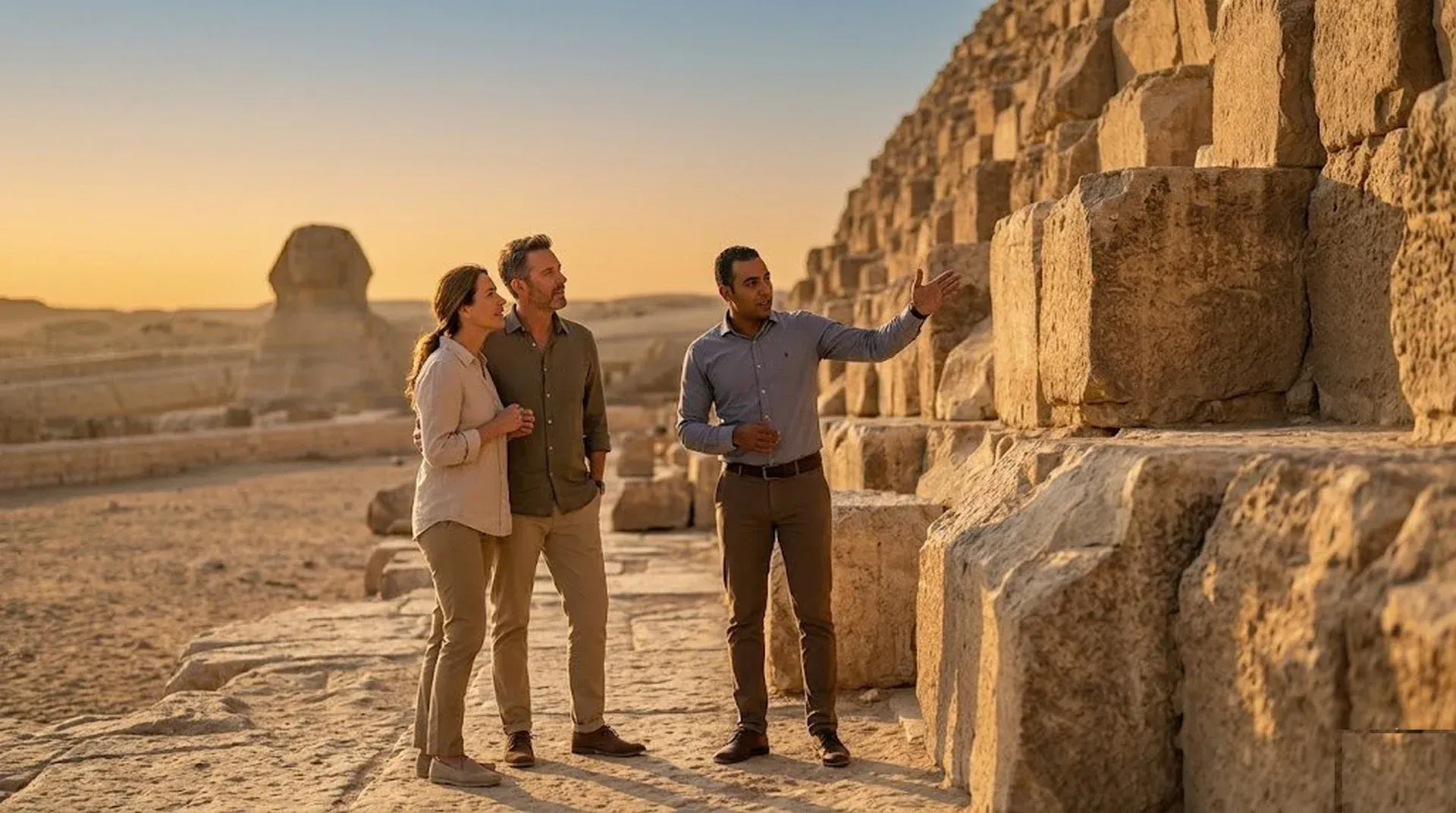
Every package on this page is private — your group, your guide, your schedule. Your Egyptologist is assigned before you arrive and stays with you for the full duration: Cairo on Day 1, Luxor mid-trip, and Aswan at the end. The same person. There are no handoffs between cities, no different guides at each stop, no context lost in transit. What you discuss at the Grand Egyptian Museum on Day 2 is still present when you walk into the Valley of the Kings on Day 6.
The Classic range sits alongside our Luxury Egypt Tours in guide quality and private model. Both categories operate identically: one group, one Egyptologist, one vehicle. The difference is the hotel tier. Classic packages use well-reviewed, comfortable, five-star standard accommodation throughout — clean and reliable, with everything a serious traveler needs. The Luxury range upgrades to deluxe five-star properties, Nile-view rooms, and spa access. If the sites and the guide are what you're buying, Classic delivers the same experience.
All packages below include all entrance fees. Every site on the itinerary, every ticket, every domestic flight — included and arranged. Many operators advertise a headline price and exclude entrance fees to keep the number low. We don't. What you're quoted is what you pay for the package.
The Packages
5-Day Classic Egypt Tour — Cairo, Luxor & Aswan
The tightest honest circuit for a first visit: the three cities that hold Egypt's greatest monuments, covered without rushing. Day 1 arrival in Cairo with a low-key afternoon in Coptic Cairo — old churches, the hanging church, a working neighborhood that most tours skip. Day 2 at the Giza Plateau and the Grand Egyptian Museum before the coach groups arrive. Day 3: domestic flight to Luxor, the West Bank, the Valley of the Kings. Day 4: Karnak and Luxor Temple on the East Bank, then the flight south to Aswan. Day 5: Philae Temple and the Unfinished Obelisk before departure.
Five days is honest about its limits. Saqqara, Islamic Cairo, and Abu Simbel are not on it. If they matter to you, the 7 or 10-day is the right choice. What the 5-day does — Cairo, Luxor, Aswan, done properly — it does without compromise.
7-Day Classic Egypt Tour — Cairo, Nile Cruise & Aswan
The most consistently well-reviewed structure in our Classic range. Three full days in Cairo: the Grand Egyptian Museum and the Giza Plateau on Day 2, Saqqara and the full pyramid circuit on Day 3, Islamic Cairo's Al-Muizz Street and the Citadel on Day 4. Then a domestic flight to Luxor and embarkation on a standard five-star Nile cruise ship — three nights moving south through Upper Egypt. Edfu on Day 5 — the best-preserved temple in Egypt, missed entirely by road-based itineraries. Kom Ombo on Day 6. Arrival in Aswan by water on Day 7, then Philae Temple and the felucca before departure.
The Nile cruise is the element travelers most often wish they'd included when booking a shorter trip. It is not a sightseeing vehicle — it's three nights on the water, watching the temples appear from the bank at dusk, eating dinner as the lights of riverside villages pass in the dark. After four days moving fast through Cairo's monuments, the pace resets something. You sit on deck in the late afternoon with nothing required of you, and the water does the work. That shift — from the intensity of Cairo to the quiet of the Nile — is what most people remember longest.
10-Day Complete Egypt Tour — Cairo, Nile Cruise, Aswan & Abu Simbel
The complete first-time circuit. Four days in Cairo covers the full pyramid arc — Giza, Saqqara, Dahshur — and the Grand Egyptian Museum, Islamic Cairo, and Coptic Cairo without rushing any of them. A four-night Nile cruise moves through Edfu and Kom Ombo. Two days in Aswan: Philae Temple, the Unfinished Obelisk, a felucca to Kitchener's Island, and a visit to a Nubian village. Abu Simbel on the final morning before departure — either by plane (45 minutes each way) or by private vehicle, leaving at 04:30.
Abu Simbel earns the strongest response of any site on a first Egypt trip, consistently. Ramesses II built two rock-cut temples deep into a sandstone cliff on the Sudanese border — and in the 1960s, UNESCO cut them into thousands of blocks and rebuilt them on higher ground to save them from the rising waters of the Aswan reservoir. The relocation is as remarkable as the temples. Most travelers who skip Abu Simbel to save a day return to Egypt specifically to see it. Include it if there is any question.
8-Day Option — Cairo, Nile Cruise & Abu Simbel
For travelers who want the Nile cruise and Abu Simbel without extending to ten days. Two days in Cairo, a domestic flight to Luxor, a three-night cruise to Aswan, then Abu Simbel on the final day before departure. This is the right structure if your priority is the Nile and the south over an extended Cairo circuit.
Red Sea Options — Short Breaks and Full Circuit Endings
Several Classic packages close at the Red Sea rather than returning directly to Cairo. After the historical circuit — Cairo, the Nile cruise, Aswan — a domestic flight takes you to Hurghada or Sharm El Sheikh for two to four nights at a five-star resort before your international departure.
The contrast is the point. You move from 4,500 years of carved stone to clear water and open sky in the space of one morning flight. Families find the beach ending gives children something to look forward to during the archaeology-heavy days. Couples use it as a natural decompression after an intense cultural itinerary. For travelers who want history and beach in a single trip without booking two separate holidays, this structure handles both.
Hurghada is the more practical Red Sea choice for Egypt itineraries — well-positioned relative to the Luxor–Aswan circuit, strong resort infrastructure, reliable snorkeling, and shorter transfer times than Sharm. Available across 8, 9, and 10-day packages. The 11-day option adds Alexandria at the start — from the Mediterranean coast to the Nile Delta to the Red Sea, a complete Egyptian arc.
Sharm El Sheikh offers a different setting entirely: the Sinai Peninsula, Ras Mohammed Marine Park reefs, jeep safaris into the desert interior, and the distinctive atmosphere of a purpose-built resort town. The 6-day Cairo & Sharm option is the shortest Red Sea package — two days of history at the pyramids and museums, then Sharm for the remainder. The 13-day version runs the full Egypt circuit before ending at Sharm.
Hurghada packages: → 8-Day Hurghada & Nile Cruise → 9-Day Cairo, Luxor, Aswan & Hurghada → 10-Day Cairo, Hurghada & Nile Cruise → 10-Day Complete Egypt Tour with Hurghada → 11-Day Cairo, Luxor, Hurghada & Alexandria —
Sharm El Sheikh packages: → 5-Day Cairo & Sharm El Sheikh Short Break — Giza + GEM only, no Nile cruise. The right structure for travelers with five days or less, or those adding Egypt to a regional trip. → 6-Day Cairo & Sharm El Sheikh → 13-Day Egypt Tour with Sharm El Sheikh
On Shopping Stops
You stood at the base of the Great Pyramid at seven in the morning. The light was low and amber, the way Cairo light is before the heat comes. Mahmoud was already there — no flag, no placard — standing by the gate with two bottles of water and a question: which pyramid did you want to go inside first? You chose the Great Pyramid. The ascending passage was narrow and warm, and you came out into the King's Chamber, and the silence in there was total, like a held breath, the stone close around you on four sides. On the way back down, Mahmoud stopped at a mark carved above the passage and explained what it said. Four minutes. It changed how you saw everything that followed.
That day did not include a visit to a papyrus workshop. Or a perfume factory. Or an alabaster showroom.
This is worth stating directly because it is the most common complaint in Egypt travel forums, and it applies to a significant number of operators: guides who take clients to these shops receive substantial commissions on sales. The demonstrations of how papyrus is made, how essential oils are extracted, and how alabaster is carved — they are structured sales pitches. The hour spent there is an hour not spent at a site.
None of our packages includes shopping stops of any kind. Your Egyptologist is paid to guide you. If you want to buy something, we'll tell you where to go on your own and what a fair price looks like. What we won't do is use your touring day to deliver someone else's commission.
Tell us your travel dates and your biggest concern about Egypt — we'll come back to you within a few hours. → WhatsApp +20 122 362 4703
What Every Package Includes
All Classic Egypt Tours operate on the same foundation:
- A licensed Egyptologist guide — university-qualified, English-speaking, with your group for every touring day from arrival to departure. The same guide in Cairo on Day 1 and in Aswan at the end.
- Private air-conditioned vehicle with Wi-Fi for all ground transfers. No shared transport of any kind.
- Standard five-star accommodation throughout. Specific hotels confirmed at booking.
- All domestic flights within Egypt are arranged and ticketed. On most packages, the final day involves a domestic flight followed by your international departure — this is the standard structure and a documented anxiety in Egypt travel forums. We manage it specifically: early-morning domestic departures, a confirmed buffer time in Cairo, and a ground coordinator who tracks both legs and is reachable throughout. If a domestic delay creates a risk to your international connection, we are on it before you are.
- All entrance fees for every site listed in the itinerary.
- Breakfast daily; lunches on all touring days.
- Private airport transfers on arrival and departure.
Not included across all packages: international flights, visa fees ($30 on arrival at Cairo International Airport), dinners, personal drinks, and gratuities.
Every package can be adjusted — duration, destinations, and pace can all be changed. Contact us with your travel dates and interests, and we'll build from there.
Classic vs Luxury — The Actual Difference
The guide is the same. The private vehicle is the same. The itinerary depth is the same. What changes in the Luxury range is the hotel: deluxe five-star properties throughout — Mena House at Giza, equivalent properties in Luxor and Aswan — Nile-view rooms, spa access, and certain exclusive additions such as Dahabiya charter options and extended GEM access.
The sites don't change with the room. If the Egyptologist and the private model are what you're paying for, Classic is the right category. If the hotel experience is as important as the itinerary, Luxury is the right one. Both are correct answers depending on the traveler.
Frequently Asked Questions
Are these group tours?
No. Every Classic Egypt Tour is entirely private. Your Egyptologist and vehicle are assigned to your group only for the full trip. There are no shared departures, no group schedules to accommodate, and no other travelers in your vehicle or at your touring pace.
What makes the single-guide model different?
On most Egypt tours, you have a different guide at each city — one in Cairo, another in Luxor, a third on the cruise. On our tours, one Egyptologist accompanies you throughout. The context built at the Grand Egyptian Museum on Day 2 is present when you enter the Valley of the Kings on Day 6. The guide knows what you found interesting at Saqqara and draws the line forward at Karnak. That continuity changes the quality of the experience in a way that is difficult to replicate with handoffs.
Is Abu Simbel worth adding if I'm short on time?
Yes. The temples are remarkable on their own. What makes the visit stay with people is the story: the 1960s UNESCO operation that cut the temples into thousands of blocks and reassembled them on higher ground to save them from the rising Aswan reservoir. Your Egyptologist explains this at the site. Most travelers who skip Abu Simbel to save a day come back to Egypt specifically to see it.
Can the packages be extended or adjusted?
Yes. Duration, destinations, hotel preference, and specific site choices can all be adjusted. Contact us with your travel dates and priorities and we'll build the itinerary from there.
→ More answers in our Egypt travel FAQ
When to Go — and What to Know Before You Book
October to April is the comfortable window for Cairo, Luxor, and Aswan. Temperatures sit between 18–28°C during the day and the plateau and temple sites are manageable on foot in the morning. November through February is the most consistently pleasant stretch — cool evenings, clear skies, and good light at the sites.
Peak within peak: Christmas and New Year week, and the Easter and European school holiday period from late March through mid-April, bring the highest visitor volumes and a 20–30% increase in accommodation pricing. Neither period is a reason not to travel — the sites are always worth it — but if you're flexible, the shoulder months of October–November and February–March offer the same weather with noticeably fewer coaches at the plateau.
Ramadan: Ramadan falls on the lunar calendar and shifts by approximately eleven days each year. Touring during Ramadan requires awareness rather than avoidance. Many Egyptian staff and guides are fasting, which affects energy levels through the afternoon. Some restaurants are closed during daylight hours, though hotels serve food regardless. A number of sites adjust their opening hours. The atmosphere across Egypt during Ramadan is like nothing else — evenings are alive in a way they aren't at other times of year, and the Iftar meal at sunset is worth experiencing. We plan Ramadan itineraries specifically around these realities: earlier starts, adjusted site sequencing, and restaurant choices that work for fasting and non-fasting travelers alike. If your dates fall during or near Ramadan, tell us — the trip is entirely plannable, it just needs different logistics.
May through September: Summer in Egypt is hot. Upper Egypt — Luxor and Aswan — regularly exceeds 40°C from June through August. Early morning starts (7am at the sites before the sun is overhead) make it manageable, and hotel pools and air-conditioning do the rest. The trade-off is value: summer is low season, which means better rates on hotels and cruise ships, and significantly fewer visitors at every site. If you're budget-conscious and heat-tolerant, it's a legitimate window.
"From the moment we landed in Cairo until the day we flew home from Luxor, Pyramids Land took care of everything. Our guide Sameh was with us for the full 8 days — Pyramids at sunrise, the Grand Egyptian Museum, Luxor, Hatshepsut, Abu Simbel, the Nile cruise… everything ran perfectly. He adjusted the schedule when we were tired from the heat, shared stories that made the history come alive, and made us feel completely safe and looked after the entire time. This was our first trip to Egypt and it was so much better than we ever expected. We have already recommended Pyramids Land to three other families."
— Sarah & Michael Thompson, United Kingdom · March 2026 · 8-day Cairo + Luxor private package
How far in advance should I book?
We recommend booking at least 4–6 weeks ahead, especially for travel between October and March when demand is highest. Nile cruise cabins sell out faster than hotel rooms. If your dates fall during Christmas, New Year, or Easter, 8–12 weeks is safer.
Not sure which duration is right?
Tell us your travel dates, how many days you have, and the one thing you most want to make sure you see. We'll recommend the right package — or build one from scratch. Most planning questions answered within two hours.
Are meals included?
All packages include daily breakfast at the hotel. On Nile cruise days, all meals are included (breakfast, lunch, and dinner onboard). Lunches and dinners on non-cruise days are at your own expense, though your Egyptologist will recommend restaurants suited to your preferences.
What happens if my flight is delayed on arrival day?
Your driver monitors your flight in real time. If your arrival is delayed, the transfer adjusts automatically — no extra charge. If a significant delay affects your first touring day, your Egyptologist will restructure the schedule to prioritize the most important sites.
Do you arrange airport visas?
Egypt offers visa-on-arrival for most nationalities. Your driver meets you before immigration and can assist with the visa purchase window, which accepts US dollars, euros, or British pounds. The visa fee is not included in the tour price as it is paid directly to the government.
Is travel insurance required?
Travel insurance is not required to book, but we strongly recommend it. Medical evacuation from Upper Egypt is expensive without coverage, and trip cancellation insurance protects your investment. We can recommend providers if needed.